Sex Work

I’ve been avoiding writing about this topic, because I know it is so sensitive and I am, quite frankly, afraid of putting a foot wrong just to speak my mind.

It is something I am undecided on, and that I find it so difficult to be decided on. I figure it’s partly a good thing, as it maybe means I’m more open to listening than on topics where I have vehement opinions.

Feminism in London (2015) took a stance on the issue by giving a platform to women who support the Nordic model, including ex-sex workers, and women who have been trafficked. When I saw this, although I didn’t agree with 100% of the methods, I was completely convinced.

At Women of the World this year, they showed both sides through performance, but didn’t try to have a panel on it (due to past occurrences I think). In turn, this meant it didn’t take a position on the issue. And I got the impression that Founder and Artistic Director, Jude Kelly, didn’t really know where she stood on this matter either.

I recently watched this video below and I couldn’t recommend it more.

It runs through the following options when thinking about sex work and legality:

-Full criminalisation: seller, buyer, third parties.

-Partial crimination: selling and buying legal, but other activities (e.g. selling on streets, in brothels) banned.

-Nordic model: criminalising buyer, not the seller.

-Legalisation: all legal!

And what do sex workers want? Decriminalisation. 

One of the issues FiL picked on with this, was how it differs to legalisation, and they argued that it doesn’t (but have a read of this). Whilst I couldn’t help but feel sympathy for people trafficked into sex work – including one speaking at this event – Toni Mac makes a good point that people are trafficked into other industries and nobody calls for a ban on the entire industry itself. But then again, I read that 95% of victims of trafficking are forced into sex work. Needless to say that most of these people are women. So, it shows that this is to do with women’s position in society; the fact that it’s a gendered issue is obviously going to provoke ideas that all sex work is a form of violence against women. But some women do choose it, so where do they fit in? Often people point out the issue with capitalism and that sex work is simply another form of exploitation. It begs the question of whether it matters whether its sex work or not.

What I find difficult may be a process of unlearning. As much as I don’t want to add to the stigma against sex workers, I am uncomfortable with what I have heard  about legalisation in Germany, where sex has been marketed within a deal where you also get a beer and a hot dog, dehumanising the women involved. That this advertising will be seen with young children, that on family tours these children will see themselves reflected differently. I really hope that decriminalisation won’t mean the same thing happening. As someone who works with young people, I can’t see myself promoting sex work as a viable career choice to those that I work with, especially when wanting to encourage young women not to limit themselves or see themselves as objects. Women are already objects in advertising for tech job recruitment and more, so how, in an unequal society, with women making up a majority of sex workers, can we make progress so that fewer women are exploited for their bodies?

For me, sex work is like no other work, which is what makes it so difficult to get my head around. However, if this is to do my relationship with sex as an act that is uniquely intimate, then perhaps what is needed is better understanding, more voices from sex workers, about the work they do and how they negotiate it with other aspects of their lives. At FiL I heard statistics about the mental processes of sex work, the disassociation, that it takes 3-7 years for sex workers to see themselves as being exploited, that many will tell themselves they enjoy their job etc. It is also where I heard the term “prostituted women” and thought I understood the phrase, only then to read something that argued that by saying that of all sex workers, you take away their agency.

Part of what I’m uneasy about is the idea that if we decriminalise sex work, that we are accepting that we can’t do anything about its existence. FiL argued “we don’t want a reform, we want a revolution.” But when that revolution appears to be impossible, it seems to make sense to do whatever it takes to protect those most in danger of suffering at the hands of these four failed models. After all, Toni Mac states that “Prohibition barely makes a difference to the amount of people actually doing those things, but it makes a huge difference as to whether they’re safe when they do them.”

She goes on to say that “you can’t simply legislate a better world into existence.” You simply can’t disagree with this statement because so much of this is cultural, and changing attitudes is massively challenging. I can see everyday with my work with children how ingrained sexism and misogyny (as well as so much more) is on this young people. Again, Toni Mac makes a very powerful point about the question “Would you want your daughter doing it?” which has been my thoughts, not necessarily in terms of my daughter, who doesn’t yet exist, but more about the young women with whom I work. But Toni Mac turns it around and gets you to imagine that she’s already doing it, asking “How safe is she at work tonight? Why isn’t she safer?”

New Zealand is the only place that has decriminalisation in place, written in collaboration with sex workers, and I guess all we can do is see what happens and hope we finally have a solution. So far, things seem to be working well. I admit, I have been guilty of seeing sex workers as either victim or privileged, and this post itself definitely isn’t perfect. But I’m trying to understand, and where I can, to learn about sex work from all voices who have the experience to speak; I will listen and try to be a better ally.

“If you care about gender equality, or poverty or migration or public health, then sex workers’ rights matter to you.” 

Feminism in London: Engaging Men in Feminism

Last year at the FiL conference I went to a similar workshop about men and Feminism. This year, The Great Initiative came to deliver the workshop, which went through a some of the activities they would do with school children as a way of engaging them within discussions on gender and equality. Although the focus is on men and boys here, it is a far cry from the misogynist MRAs one can get used to trolling online. The men who are serious about addressing gender do so in a pro-Feminist way. Through ‘Great Men’, they aim to disrupt gender stereotypes and engage participants in the movement towards gender equality. The diagram below shows how they go about this.

workshop-topics

In the workshop, we started with word associations on big pieces of paper connected to men and women. The main bulk was in groups, where we discussed pros and cons men being engaged with Feminism. Our initial reaction to the task was that there simply aren’t any cons to men being engaged with Feminism. We then thought more about it in terms of either the act of engaging men itself and what are essentially maybe teething issues, so things like feeling men are to blame rather than it being about a system of power, but arguably paradoxically having to think about being in a position privilege and how that can be used for making the movement stronger. Yet, in terms of men who are engaged in Feminism, there may be a resistance to, in some ways, giving up power, and in turn a danger to dominate rather than listen and try to understand how life is coloured with experiences of being a woman. I managed to take a photograph of our notes on the topic. When the discussion was opened up, we managed to summarise, and there were moments where it descented into debate, but at the end we were left with this list to keep in mind, and some tools and approaches to engaging men and boys in Feminism.

IMG_3332

Body Hair: Armpit Alert

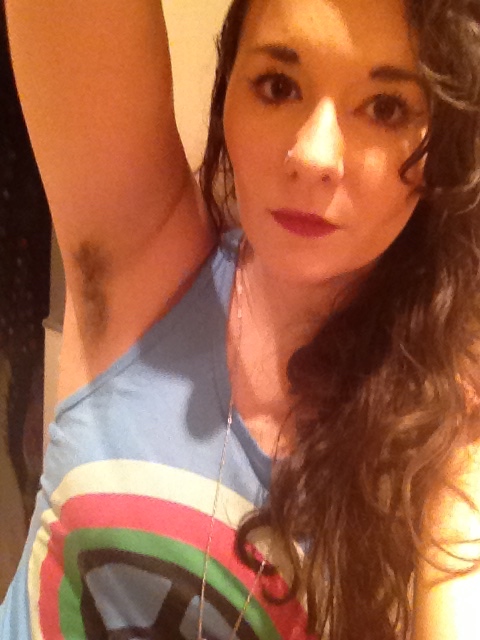
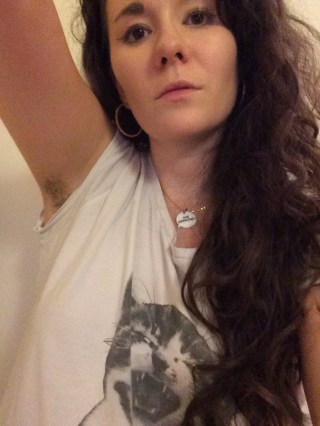
Dr. Breanne Fahs has been quoted to say that when a woman shows her armpit hair it “becomes an act of political resistance because it highlights the presence of an otherwise silent or erased aspect of women’s bodies.” It’s winter, so it’s been an act of political resistance that has been easy to embrace. The picture below is probably the closest I’ll get to exposing my hairy armpits to the world. When not on show, I’m happy to grow! But if I’m honest, there’s a deep-seated attitude ingrained in me that probably underlies just why I will continue to shave in the summer months, despite the fact the hair grows back within what seems like minutes, and with such sensitive skin, it’s near impossible for it to be smooth unless the optimum amount of time is left in between shaves.

IMG_3391.jpg
How more hippie can you get?

It’s not complex to work out why I’m embarrassed to bare my hair on the beach. I think it’s around 90% of women who remove armpit hair. It even feels a little silly that messages that are so obviously articulated are still able to influence me so powerfully. I remember when I was about seven years old, in Italy, I thought I saw the armpit hair of an older, American girl. It seemed like such a shock to me. I remember telling my Mum, who has, of course, handed down body-hair shame to me like a precious heirloom.

When I started to grow hair there myself, I was still at primary school. A girl saw that I had hair there. It was almost like I hadn’t noticed it myself. I don’t remember thinking anything of it growing there until it was pointed out to me by another girl. This was obviously accompanied by an “urgh!” All it took was these two experienced, strong enough for them to stand out in mind mind all these years later, to form this idea that I’m not presentable in my natural state.

IMG_0010

Maybe one day, I’ll become brave enough to step out in the real world like this. But for now, this is as Feminist as my armpits get. Meow. Just had a massive curry and going to have a bath, eat chocolate in front of telly, half wishing I was dancing to Beyonce (but only half, because I’m like 26 now, getting old, staying in for NYE etc). #Iwokeuplikethis #flawless

One-Liners: Edinburgh Fringe Festival Reviews

I’ve written more detailed reviews for The Norwich Radical on shows by the Kitten Killers, Luke Stephens, Kate Smurthwaite, Pole and Hannah Chutzpah. Here I’ve included some smaller reviews to give you a flavour of some of my other many highlights.

Megan Ford: Feminasty

Satirical, character sketches and comedic speeches on gender, Ford switches between characters to connect comedy to more serious issues. We get a cool, informative zine on the way out, and a badge.

Shazia Mirza: A Word In Progress

There were moments I wasn’t sure about: the mention of ‘political correctness’, jokes about fat people, and Jewish people, and the upset at the mention of the girls who left Bethnal Green Academy. I work at the school down the road, and it’s something that directly impacts on the students I teach, but perhaps the point was to create discomfort. The theory that they went “for dick” seemed sadly poignant once the laughter died down and we were told that “epilator, knickers and body lotion” were on the top of their packing list. This is a slightly longer review, because I’m interested to see where the show will go, because, although funny, the ending – a commentary on Islam and so-called “ISIS” was momentous and powerful.

Bridget Christie: A Book For Her

There were at least three acts who mentioned the tax on sanitary products, but Christie suggested the ingenious idea of sending bloody knickers with “END VAT’ on them to George Osborne. In this show, she gave an ironic definition of what being a Feminist means and turned to politics in the UK and USA, with an intersectional focus on race issues.

Katherine Ferns: Conscious Incompetent

I disagreed with points made about “manspreading”, which is simply indicative of patriarchy, and as much a part of it as anything else, I didn’t like jibes at Beyoncé, and I didn’t like the use of the word “retarded”. However, she also made the obligatory tampon tax joke, and her ability to touch on taboo subjects such as incest, rape and pedophilia was both clever and somehow funny (and not in an offensive way). She spoke frankly of what difficulties in her life, from depression to drugs, and weighed up whether decisions she’d made were brave or stupid. Well, I’d say the brave outweighs the stupid.

Jack Rooke: Good Grief

He probably won’t want his youth commenting on, but I left Rooke’s show in awe of what he is doing. Not only has he created this wonderful show, which has the perfect balance of comedy and more sombre moments, but he is symbolic of how the personal is political. What goes on with the government directly impacts on our lives, and through The Good Grief Project, he is challenging current changes to the Widowed Parent’s Allowance.

Harry Baker: The Sunshine Kid

You couldn’t help but smile throughout this show, as Baker took us through his life prior to university to now through his poetry, which can be found in the book of the same title by Burning Eye Books.

David Lee Morgan: Building God

An intense show about revolution and communism, Morgan’s voice kept audiences captivated through his ways with words and the beat of the music he played as a backdrop.

Stephanie Laing: Nincompoop

A show about shame that started with not letting an old lady sit down, and inevitably went on to talk about drunken behaviour, bad dreams and sexual antics. With songs and a flute, Chesney Hawks, and a serious note about shame and self-harm, what’s not to love?

Bryony Kimmings and Tim Grayburn: Fake It ‘Til You Make It

I gave this show a standing ovation. I’ve never been made to cry from watching dancing before this. I bought the play text, but I wish I could relive the experience as I read. Bryony Kimmings and her real-life partner Tim Grayburn use comedy, dance, and spoken word to speak about mental health more honestly than I’ve ever seen before. It was incredibly touching and I wanted to cry a lot more than I actually did.

Sophia Walker: Can’t Care, Won’t Care

An insight into the care industry through a legal battle between the state and the carer. This shows as in with such jobs, there is minimal pay and agency for those who truly care about the individuals they work for, the service users. It was honest and passionate, and so heartbreaking.

The Kagools

No words and a whole lot of audience participation. I was thankful to do no more than eat a Hula Hoop. The best part was their use of pre-recorded material on the screen, and that whilst it felt like each part was a random act, it tied neatly together by the end.

Elf Lyons: Being Barbarella

I loved the Feminist angle of wanting to be this confident person, and wanting to be empowered sexually and otherwise. Lyon’s mis-matching accents was especially funny, as well as her use of costume.

Ben Norris: The Hitchhikers Guide to the Family

Ben Norris explores his relationship with his father through a hitchhike through all the places his dad had lived, proving an interesting story that explored masculinity as a whole and was sure to connect with many men in the audience.

Aisling Bea: Plan Bea

I loved this and was laughing constantly. She had good accents and I liked the reclaiming of ‘girl’ as a word of complexities, and there were slight political points, but worked in a subtle way. Again, this was about confidence and owning your own “shame” (her being in this heavy metal pirate video)

Mark Watson: Flaws

A show about flaws, obviously, and lacking self-esteem, mental health issues and turning to alcohol. Watson is such a warm character that you can’t help but warm to him (unless you were one of the three women who left after fifteen minutes).

Paula Varjack: How I Became Myself (By Becoming Someone Else)

A really interesting piece, as well as in terms of subject matter – the idea of changing your identity – but also in terms of how this was done visually – mixing front performance, through the camera and on screen. 

So It Goes

Another show with no words spoken aloud, but written on white boards, using props and dance to illustrate the story of Hannah’s dad, dealing with his death, and her friend David helping her to tell this story. There was laughter, and many, many tears.

Sara Hirsch: How Was It For You?

‘I can’t rhyme you,’ Hirsch proclaims, asserting why she can’t write a poem for her then-boyfriend, in the middle of what is almost a long love poem to the ex in question. But it was also a love poem to herself, and for everyone out there searching for love and the meaning of life.

Jemima Foxtrot: Melody

Beautifully intricate language, so poetic and mixed in, as the title would suggest, with a’cappella song. Foxtrot plays with humour and the unexpected in this wonderfully crafted piece.

Kirsten MacGregor: Hello Cruel World

I couldn’t believe this comedian was just 18 years old. It wasn’t only her grumpy persona that made her seem mature, but her confidence and comic timing.

Michael Burdett: Strange Face – Adventures with a Lost Nick Drake Recording

Really interesting true story of… well, it does what it says on the tin. There’s a book with lots of people, including well-known people, photographed whilst listening to the a rare recording of ‘Cello Song’ with their stories.

Mark Stephenson: Amsterdam

A hilarious story about an absent father, a beautiful marriage and selective mutism. Or it is? Very much recommend.

Izzy Tennyson: Brute

I find it difficult to create characters that exist beyond binaries of good and bad, yet Izzy Tennyson managed to do this in the creation of ‘Brute’. In the classic conversational style of Tennyson, she embodies a teenage girl to tell a story that is familiar in the sense of going to a single-sex state school, but looking into why girls can be bullies, exploring the complexities of a psyche so often dismissed.

Dan Simpson: Nerdsmith

Reading poems from his Burning Eye Book, Applied Mathematics, Simpson attempts and admittedly fails to get to the heart of an emotional provocation. But at the end, it’s okay, as the audience enjoy his playing with language, from puns to extended metaphors. I bought his book in hope of some poetic inspiration!

Tim Renkow: Kim Jong-Un, Mohammed, Jesus and Other Power-Hungry Maniacs

Renkow was knowingly provocative in his comedy from the onset, warning the audience that his record number of walk-outs is nine people. However, I was most offended by the implication that, in telling an anecdote to illustrate negative attitudes to disability, his erection was due to the woman’s “fear”. There were certainly other moments where I questioned where he was going, but you didn’t have to wait for long to see that he was mocking injustices he sees in society.

So, it was pretty much all amazing…

There were some I enjoyed more than others, but the only show I was completely disappointed by was Tony Law. I’d seen him before, but a majority of this improvised show I didn’t find funny, and on top of that I was worried about him, especially when he started to drink a pint after telling the audience he’s quit drinking. I hope he’s okay…

News: She Grrrowls and Audio Book Radio

She Grrrowls is settled into its new home at Apples & Pears – it’s crazy to think that half a year has gone, and 16th July will be the last event before the summer break (all being well, returning in September). Check out what you missed last week:

In other news, I’m currently working on an anthology of ten poets from the She Grrrowls alumni after receiving funding from Ideas Tap to commission some new poems. I just need a publisher now! I’m hoping to get it out for December to have a launch event.

I’ve also been listening to this radio documentary, with poetry by Kate Tempest after having listened to lots of clips shared by Falling Tree. Again, you can listen to it here:

Speaking of radio, I’ll be having some poems featured on Audio Book Radio. Tune in on Friday 26th June at 2pm, 10pm and Saturday 27th at 6am.

How Not to Talk About Intersectionality

Changing Families and Feminist Blind Spots: Have female-friendly policies been captured by middle class feminists?

When giving up an evening to go to a talk on with the title above, you would probably be fair in making the assumption that this would be a discussion amongst identifying Feminists, with a focus on intersectionality, touching on issues of class and race. Or at least that is the assumption I made, when invited by a colleague. It is only now that I read it another way; ‘feminists’ here are The Other, separated from everyone else.

It began with a presentation by Professor Baroness Alison Wolf, yet throughout the evening, it seemed that she was most concerned with promoting her book ‘The XX Factor: How Working Women are Creating a New Society’. If Wolf was meant to be the spokesperson for Feminism, her voice was not strong enough, and she often put her foot in her mouth. For example, when making the assumption that the room is full of middle class people, what are you then saying about working class people? By making a sweeping generalisation on the audience appearance, Wolf was unable to address the complexities of class as it is now. She talked about 15-20% percentage of women being highly educated, and the rest being ignored by Feminism, which may be true of certain strands of mainstream Feminism, but within that she ignored the gap between herself and a lot of women who would be deemed middle class. The middle class is a wider demographic that Wolf presented.

When Wolf began her presentation, she was aware that it may be seen a controversial. At first I wondered if what she was saying was deliberately done to make us feel uncomfortable. That would have been a great tactic. However, as she went on, what she said seemed more illogical and simply not that well informed. She may know her economics, but she doesn’t know her Feminism. I’ve followed the work of The Crunk Feminist Collective for some time, but there are plenty of examples of intersectional Feminism and no mention of this aspect of Feminism today at the event. There are also writers such as Bridget Minamore and Chimene Suleyman writing for Poejazzi who touch on these topics. Here you can read articles such as ‘The “Fierce” Black Woman Inside You Desont’ Exist”  (Minamore) and ‘Fighting against the fetishisation of women, doesn’t work if you fetishise women’  (Suleyman), which are Feminist, and offer a valuable critique of the type of Feminism Wolf was attempting to address.

Wolf’s point about working class women was lost by ignoring the women she claimed to be speaking for. But why was she speaking for them at all? Would it not have been better to actually bring women who identified as working class and allowed them the space to get their voice heard? Instead, Wolf presented a case of topics that mainstream Feminists were concerned about and put them up against what was happening elsewhere in the world. However, there was only one example that actually included a gendered news story, and if we are talking on Feminism, this should have been the focus. What was also concerning was the way Wolf talked about rape, which was extremely dismissive. She even went on to say that people are interested in rape because society is obsessed with sex and violence. She seemed not to realise that rape is not about an obsession with sex, but more about power.

Furthermore, women are arguably more vulnerable to rape if they are from a lower economic background or if they are not white, with these factors also being an influence on what happens in the courtroom, should it be taken there. But there was no mention of this, no mention of rape as a weapon of war in places such as the Democratic Republic of the Congo, and I’m not sure there was even mention of the 200 Nigerian girls who were kidnapped in April 2014. Four girls who escaped said they had been held in a camp in Cameroon and raped every day. And she claims that our concern about rape is so we can “feel victimised and superior at the same time.” . The media may have their own agenda, but to imply that we don’t care about these issues just doesn’t make sense.

Mainstream Feminism needs to take notice of how gender, class and race intersect, but this didn’t seem to be exactly what Wolf was saying. She didn’t engage with the role of the superrich 1%. She seemed to want to show that women’s progress has damaged women, and a lot of her argument was based around the idea that a childless woman is a “problem”. Whilst I agreed that more collectivist methods are needed in order to benefit working class women, she spoke of an “individualistic and career-orientated elite” and didn’t really consider who the elite actually are. She made the mistake of criticising others, whilst not looking at her own faults, and including herself in the problems of Feminism, and showing ways in which we all can listen to the voices of working class women.

In the audience, there were stifled noises of exasperation. But if we thought that was bad, we hadn’t seen anything yet! Belinda Brown was next to speak, and she certainly didn’t offer the critique we may have imagined. She spoke about gender trumping class, and didn’t seem to understand the point of intersectionality, that Wolf had touched on by stating that in terms of the pay gap, gender only becomes an issue for those who are from a lower economic background. Whilst this in itself is debatable, this widening gap is a concern; it is a Feminist issue. Brown spoke about women at the top damaging men’s jobs, but it was when she made a joke about women spending money shopping that I was sure that I wouldn’t agree with a word she said.

To be fair, she touched on one point of common ground. Women who have children are obviously biologically forced to take some time out of work to have children. We shared the view that part of the problem is that, where women are the main caregivers, this work is not valued as work. Because society doesn’t value a lot of the work women do, both at home and the type of positions women tend to take, this means that they also face the brunt of financial problems. Yet, because Brown was clearly anti-Feminism, she was also unable to see that men are also the fathers of their children. She repeatedly failed to acknowledge this, and therefore didn’t see a way of this changing. She didn’t see that a more equal distribution of childcare was needed. She didn’t see that this is an issue that runs deeper than class, that middle class families are also struggling to afford childcare, that this is a massive societal problem. Brown became flustered when confronted with the slightly bit of opposition (and believe me, a lot of people held back saying anything), and she brought her personal life as a carer for her partner. Whilst I couldn’t fail to feel sympathy for her situation, I also wanted to (metaphorically) shake her. It didn’t make sense that she could see how the value of her carework is seen as lower than her academic work, and yet couldn’t see that this view is due to the patriarchal structure of society. She couldn’t see that this also links to other power structures such as Capitalism and historic white supremacy.

The whole evening was such a mess that even the chair, Emma Barnett, had to step in to confront what was being said. Frankly, I would have rather listened to what Barnett had to say than either of the actual speakers.

Women and ‘Banter’: What are her choices?

Ellie Holland is a news reporter for series 7 of London360 – a show which uncovers the hidden voices of London’s communities. She came to She Grrrowls in the summer to feature some of the show and interview me. You can find me discussing my poem ‘Risk’ on her YouTube channel, and Rowena Knight, one of the loyal volunteers at She Grrrowls, performing her poem ‘Garlic’. At our meeting, I found out more about Holland’s specific interest in gender and burlesque, which you can find out about on this Huffington Post article.

“If a friend made a rape joke in your presence, what would you do? Carmina Masoliver, who runs spoken word and poetry event She Grrrowls, reveals her experience.”

Lastly, you can also hear me talk on October 6th show for London360, 8.38 minutes in.

Feminism in London Conference: Part 4

IMG_2543
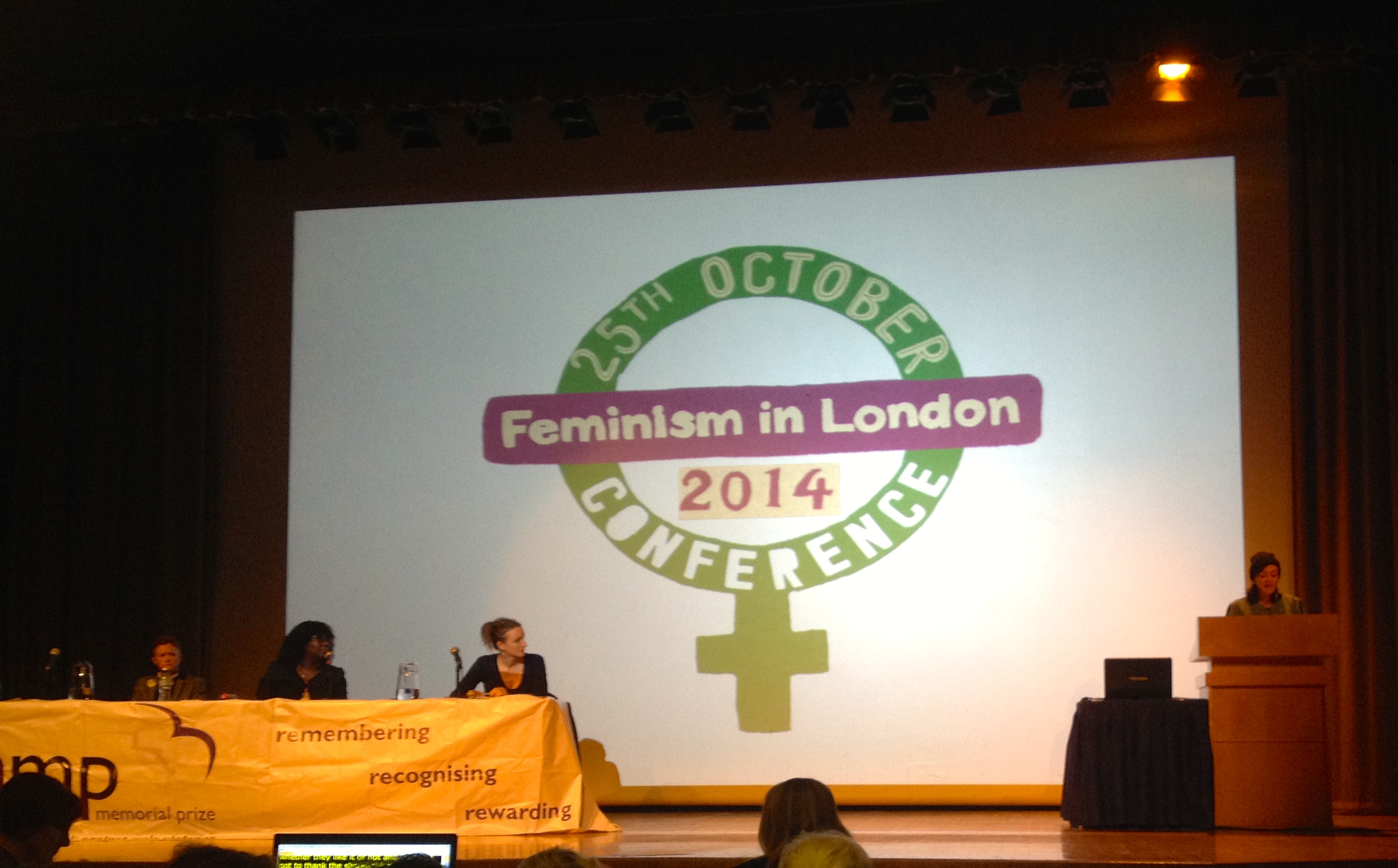
At the end of the conference we gathered for the final speeches and the Emma Humphreys memorial prize giving. Much of it was very moving, as well as being informative on some of the work that is happening with regard to violence against women. I didn’t feel it packed a punch in the way that other moments of the day had for me, but this was probably just because the opening talk had been so important and eye-opening for me. Along with the talks on shadeism and men’s role in Feminism, I’m now looking to build upon areas where there are gaps in my knowledge and experience, as opposed to reinforcing what we already know. That said, it is always needed to rally up support with speeches like this where there is a resurgence of energy, to keep us going, to keep us fighting.

I also really enjoyed Sabrina Mahfouz’s poem, which incorporated different parts of the day that she had experienced. Possibly out of paranoia, I had been wondering why I was not seeing the successes of some other poets, and worried that maybe I have been to vocal about my views, that I was being labelled to extreme. In person, I have faced little opposition, but still some opposition, to She Grrrowls – I’ve been told that the logo is scary and off-putting, that I’m creating a problem in what is already an equal community, simply for featuring women in the arts at my event. So, it really helped me to see Sabrina Mahfouz up there, proud to be a Feminist, yet also managing to be an extremely successful poet, amongst other things. Since feeling this fear that I would be jeopardising my career by being so outwardly Feminist (a fear that was expressed in the conference to explain why women would not use the label), I cannot express fully my gratitude at seeing Mahfouz take to the stage and be involved in the Feminism in London conference.

IMG_0073IMG_0074


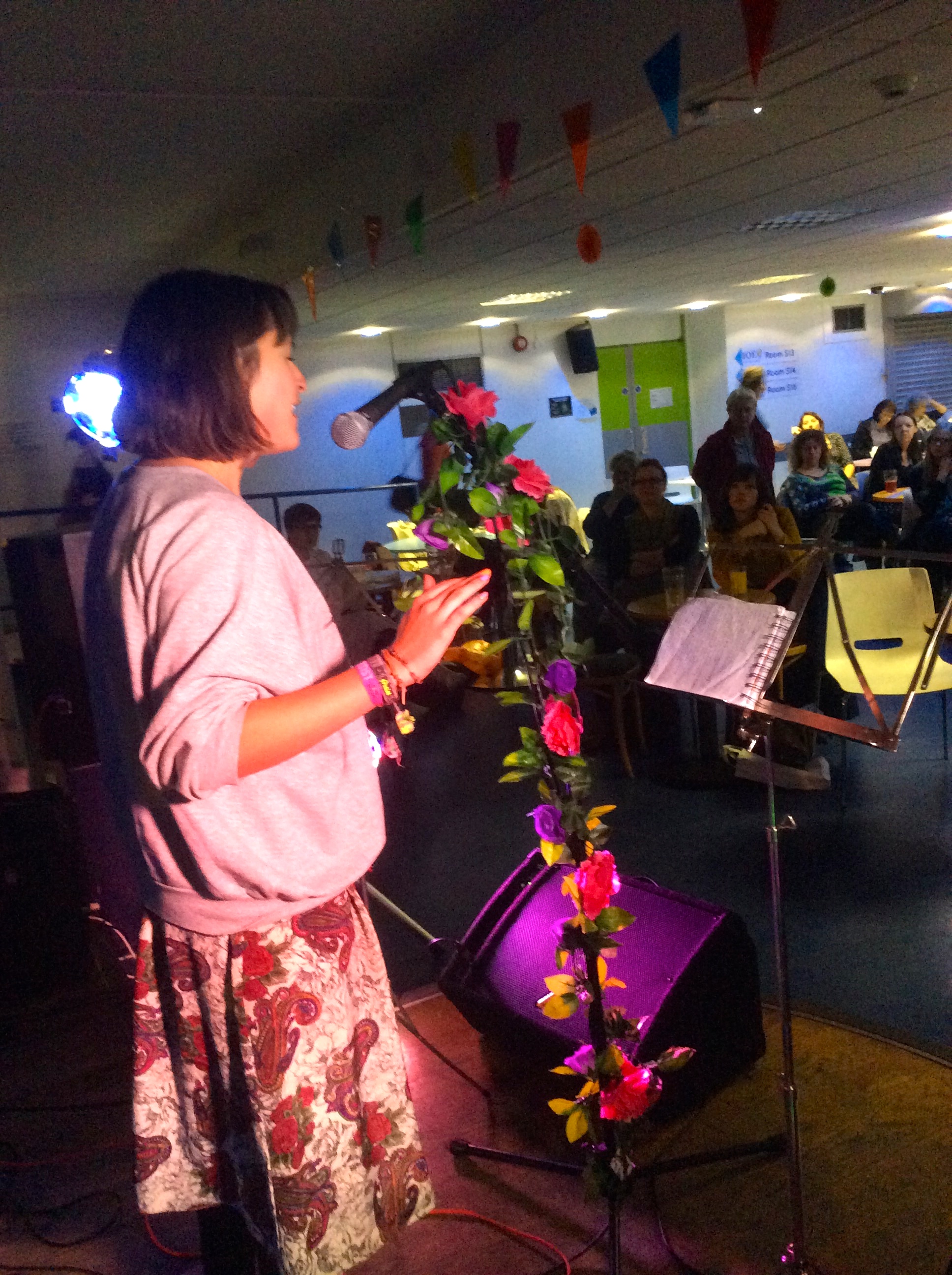
After the conference, we headed to the SU bar for the after party. I was joined by Rose Swainston and Maeve Scullion (pictured above) to represent Kid Glove. Kate Smurthwaite was also featuring; I mentioned something I found problematic in my earlier post, but other than that, she was the performer I most enjoyed that evening. I also enjoyed the other poetry act, Mabel, and the women who sang Spanish and English songs on her guitar. I felt proud after knowing ‘mujer’ meant ‘woman’ (sadly, due to Duo Lingo, not my Spanish heritage). Without wanting to dwell on negatives, I was really taken aback by a woman who, after a poem on personal experience of a rape-joke, called out ‘I’m not clapping to that, it was awful.’ And soon after, said to another woman ‘are we going?’ She was very near the stage and she didn’t try to hide what she was saying – quite the opposite. I felt close to tears, but as we were rotating poems between the three of us, I had to put it to the back of my mind and tell myself she must not have understood the poem. I stayed for a bit of the Stepney Sisters, but left early as I was tired and had a long journey to go back to the suburbs. I’m already looking forward to next year’s conference and wonder where I will be on the journey of Feminism then.

IMG_2548IMG_2549


Feminism in London Conference 2014: Part 2

Parts 2 and 3 deal with the morning and afternoon workshops that I attended at the Feminism in London Conference, which were on Shadism and Men’s role in the Feminist movement. In the first workshop I wanted to learn from the experiences of WoC (Women of Colour). As I am White European, I didn’t feel I needed to relate any experiences, despite the encouragement from Femi that all people present should speak if they wanted. Sure, I may have had things to say about friends, and about how having a Spanish name and curly hair has coloured my experiences, but I just didn’t think what I had to say was of that much relevance in such a short space of time, other than reinforce the points that were already being made in connection to shadism. I mostly listened, and only commented at the end when I urged people to help with the education, suggesting the TES website as a place to upload texts that could be read for English that deal with issues of race and gender etc. As again and again education is highlighted as being so important in opening a dialogue on these issues, I feel I am currently in such a privileged position and I need to take action.
Just to start off, in case you aren’t aware of what shadeism/shadism means, then I’ll give a quick definition. It is the discrimination of individuals based on skin tone, which can be both intrinsic and extrinsic to the race or community. It is heavily connected with the false perception that the closer an individual’s skin is to white, the more superior they are to other members of their race. It is something steeped in historical oppression, and often connects to class and other issues. Its place within the conference is also due to the fact that it often relates more strongly to women, due to the pressures of beauty standards. A film exploring just one aspect of this issue is the documentary ‘Good Hair’, presented by Chris Rock, which I saw a few years ago and was mentioned during this workshop. You can watch the trailer below… although it’s advertised here as a comedy, it’s definitely mixed with a whole dose of tragedy as humour is used to explore something that really is no laughing matter. [Edit! My friend, Natalie Cooper, drew my attention to the fact that ‘Good Hair’ is actually a rip off of ‘My Nappy Roots‘.]

Some of the points that were raised included (text in brackets shows my own points):

-The need for colour-blind casting in schools and in the wider world of acting.
-Comments on hair and touching without permission.
-Stereotypes: people saying they do not “sound Black” or white friends saying they do not think of them as Black.
-Older relatives handing down bleaching cream to young children.
-Members of the family being treated differently due to skin tone.
-The importance of language. It was strongly felt that to label oneself Black and have pride in that was vital in making a political statement.
-In a similar vein, it is up to the individual whether to a mixed race person identifies as either Black or White. This connects to people picking out features that go into either category, and it was asserted that it should not matter, should not be asked.
-The importance of encouraging girls to keep their hair natural until old enough to make an informed decision.
-Self-hatred is an important issue, which is why it is important to still tell young WoC that they are beautiful.
-WoC need more visibility in the media, advertising, in high street shops etc. (To ignore beauty and consumerism is a privilege.)
-The fascination with White people wanting to be tanned. It is that they want to be darker, but do not want the problems that come with being a WoC. White people need to understand the politics of bleaching is very different to wanting to tan. (However, seeing a mixed race tone as the ideal is problematic in terms of it perpetuating shadeism.)
-There are assumptions that Black people don’t care about appearance, when statistically they spend more money on this.
-White people should be able to describe someone as Black, yet it was also noted that this should not be to the extent that these White people do not see anything else.
-Stickers on things such as bleaching or “lightening” products (it’s the same thing, people, which is why I was disgusted at a poster I saw at a sk:in clinic). Consciousness raising.

By the end, it felt like we had only tapped the surface of shadism. We tried to conclude things, to come up with solutions and action plans, but each time women would return to speak more about their experiences. I don’t feel it is my place to even do more than share this list of points, but I hope that this post will be informative for white people, and that WoC who were unable to attend may be able to voice their own experiences and open up discussion, between friends, family and online platforms etc. Lastly, I have since come across an article by Victoria Bond which stated something that resonated with me: race is a spectrum, not a dichotomy.

Feminism in London Conference 2014: Part 1

IMG_2542

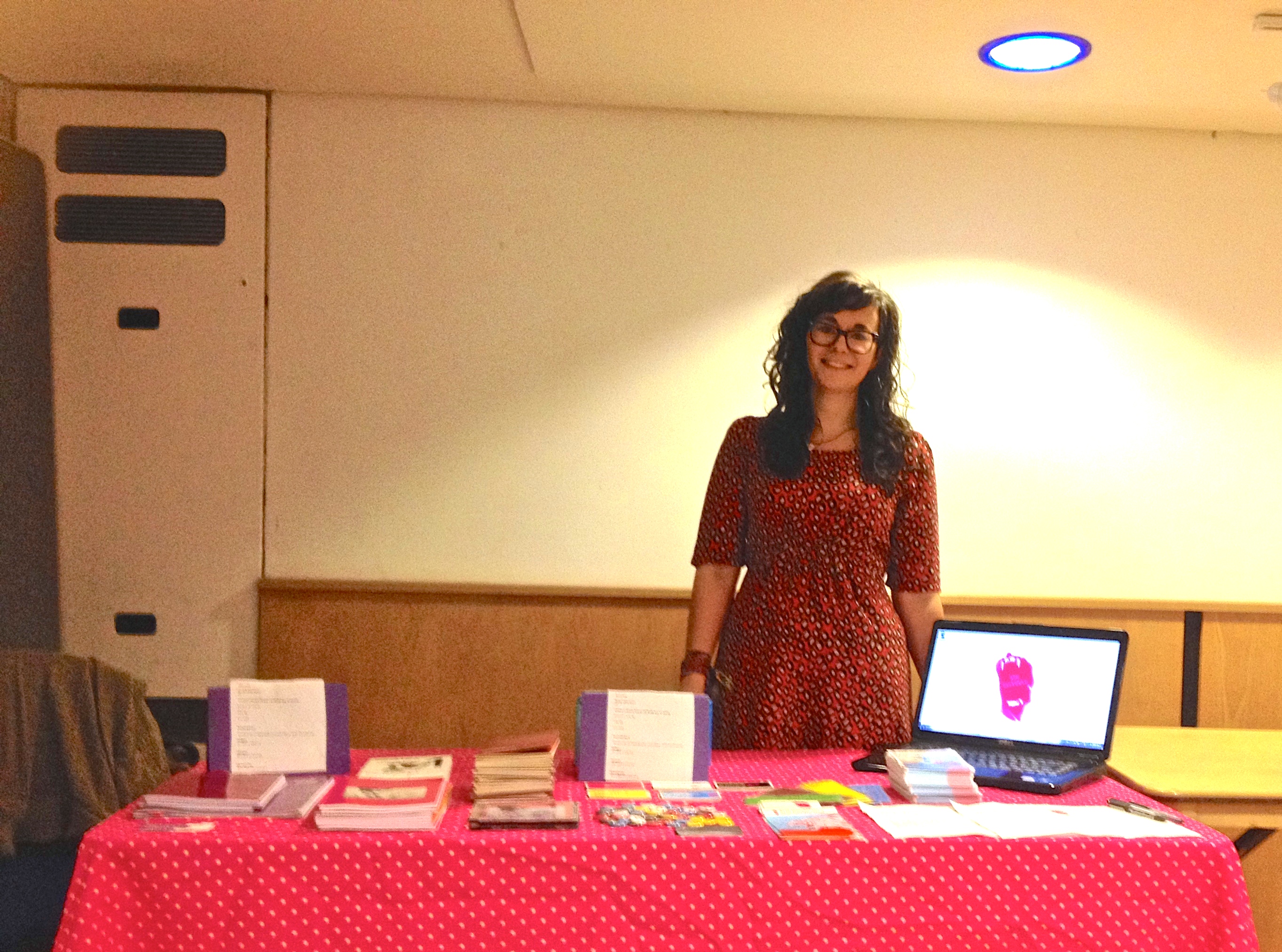
This year at the Feminism in London Conference  I was holding a stall and performing at the after party. My wonderful Mum actually held the store most of the day so that I could enjoy some workshops. In hindsight I wish that I had told her to come along to some of the goings on. I was there promoting She Grrrowls and selling books and other merchandise, such as my Nasty Little Intro. I’m going to divide it up into different posts, or else it will be very long!

From the very first talk of the day, this year’s conference felt very important for me. Last year I wrote a blog post where I detailed my thoughts on the ‘Stop Porn Culture’ talk and I was unsure on my views on porn. I hate to say it has actually been my boyfriend whose views have swayed me into thinking that porn is always exploitation of women. This year it was forcefully said that the Feminist movement needed to agree on this issue and it made me wonder whether my desire to accept that there may be such a thing as Feminist porn is actually too much of a compromise. I still feel like I need to do more research in this area. Even speaking on a similar issue with my boyfriend this week, he didn’t see the connection between the exploitation of women in porn with those on the streets. I guess we both still have some figuring out to do!

What I was talking about was one of the biggest revelations of the weekend for me. There was a distinction made between the language of calling what I would normally call a sex worker, with calling someone a prostitute, and then again with the expression ‘a prostituted woman’. This phrasing highlighted the fact that prostitution is not something that a woman does, but rather, as the verb suggests, something that is done to her. So, even when a woman is not trafficked into the sex trade, it is always going to be a form of exploitation. Some may argue that this is not the case. This is why I would really like to see some statistics on the role of choice in sex work, though I’m aware that it isn’t always going to be quantifiable as it is such a complex matter. At the conference it was argued that to call it ‘sex work’ is to legitimise the work. I feel that to legitimise it and for a sex worker to say ‘I am a sex worker and not a prostituted or trafficked woman’ actually comes from a privileged position. This is where other kinds of intersectional systems of power come into play (something that was discussed last year). How much can ‘choice’ be a factor, I wonder, when a woman has suffered physical and sexual abuse, when a woman suffers from mental health issues, when a woman is addicted to drugs, or when a woman is living in poverty? Are there any women out there who are not white, middle class women who call themselves sex workers? Is selling your body ever something to be empowered by?

Now, to be empowered is something else that was being discussed in this talk. At this point I will say that throughout the presentation I felt like an outsider. It was suggested that the opposition between second and third wave Feminism wasn’t generational, but ideological. However, I cannot help when I was born, that my first experience of any form of Feminism (that wasn’t in history books) was through the Spice Girls and riot grrrl music. I started to feel like I was in an environment where I would be judged for my liking the colour pink, that I shave my legs and get Brazilian waxes, and that I have performed pole dancing routines (not because it was empowering, but because it was fun). I felt that the second wave was being held up as the “right” form of Feminism, and that third wave was too problematic to take anything good away from. I will always be grateful to the Feminists that come before me, but I have always taken issue with some aspects of second wave Feminism, notably the transphobia that has been exhibited by those such as Germaine Greer. On the other hand, more liberal Feminists such as Caitlin Moran have also came out with some problematic things (and, for the record, you need more than a vagina to be a Feminist in my opinion – something asserted during this opening talk).

Negativity aside, I hadn’t thought about radical Feminism and liberal Feminism too deeply. I had always just thought I was a Feminist and not considered the different types within the movement, which may be something I should think more about. I had another revelation whilst listening to the talk. This was with regard to Feminist literature and how the focus has changed through the waves. It was outlined that during the second wave the focus was on the collective liberation of women, whilst now there is more emphasis on the empowerment of individuals. I found this extremely interesting as I am of the view that the Feminist movement is about collective liberation. I think perhaps the focus on individuals has become skewed from introducing a more intersectional Feminism (of which the talk stressed too) and that a collective voice needs to be formed of all individuals’ voices.

What I think is needed is a merging of both waves, perhaps a movement into a forth wave. There was some playful competition between the Dance Squad at UEA and the cheerleaders. Despite being in the former, I found the mockery of the pyramid of cheerleaders problematic. To be a cheerleader is to be underestimated, and as Feminists, we should not do the same. To be a cheerleader, you must train really hard and, like pole dancing, it is essentially a form of gymnastics and it does not need to be sexualised. This is something I have written poetry about and I feel very strongly about. It angers me that the sexualisation of these sports or art forms has created a sense of stigma around it, so that I feel like I cannot be proud about this video. This is precisely what the term ‘slut shaming’ is about. It seemed like this was being misunderstood – third wave Feminists are not saying that women who are called sluts are sluts, they also believe that there is no such thing as a slut. However, what are second wave Feminists doing when they judge the woman who is cheerleading, pole dancing or even performing a burlesque routine? They are slut-shaming. All these activities, I believe, can be done as a Feminist. This does not mean they are Feminist simply due to the performer having a vagina, but that they can play with the art form in a way that does not mean they are being objectified.

I think it is important to critique one another when not supporting the values of Feminism, but sometimes there can be a danger of mocking women in terms of personal taste. As much as I love Kate Smurthwaite and have found a majority of what she says extremely funny and witty, I don’t think we need to make fun of successful women like Victoria Beckham in the name of Feminism. I’m not completely sure where she stands on Feminism now, rejecting it in the past, perhaps due to education on the term, but she has joined the ‘Ban Bossy’ campaign to encourage girls to be leaders. Again, I think hair removal is a matter of personal taste; I don’t think women should be judged either way. I admire women who don’t share their armpits etc. However, I can remove my hair and still be mindful of the complexities of the reasons why I might do this, even though on the surface it feels like a free choice and something I prefer to do in order to feel feminine, or so that I can feel confident and happy with how I look, or simply because it feels nice to have smooth skin.

I think when it comes to sexuality, it can get really complicated. I was disgusted to hear about pornography where a woman was spat on, called a slut, had her head flushed down the toilet whilst penetrating her. I was shocked to hear that these films and photographs were not even that extreme, but easily click-able for pre-teens accessing mainstream pornography (I think this comment referred to boys, but really, it is both boys and girls who are exposed to this, who are curious about sex and who will discover this content). Then again, there was a part of me that questioned how this applies to BDSM relationships. Again, this is not an area I know much about, and anything that may degrade a woman does make me feel uncomfortable. It was simply a question that arose in my mind, wondering where these people may fit into these ideas. Nevertheless, BDSM relationships are not the point here. This is about pornography and this talk did not shy away from making a strong case to oppose pornography. It did more than my unsure rambles can do and so I would like to hear more about the exploitation of women in porn, so I am able to feel confident that by being completely against porn of all kinds, that I am making the right decision.

So, in summary, I have a lot more research and reading to do before I’m clear on where I stand in terms of the sex industry. However, this presentation has had me more convinced that I need to stand against it, if even purely for the reason that we do not know whether women are being exploited – do we really want to take that chance just because 5% of these women claim they feel empowered? This is also so tied up with Capitalism, with complicates the concept of free choice here. I would love any recommendations on where I can go for information and statistics that could persuade others that porn is always bad for women. This talk also made me think more about the distinction between radical and liberal Feminism, and I feel like I am somewhere in between the two and that perhaps we need a fourth wave to emerge in order to be clear that it is individual voices that form a collective voice, that we need to include intersectional perspectives in a way that makes our voice stronger and not weaker. I apologise if I seem to contradict myself, or if this post doesn’t seem well-structured – working out what to think on these issues is difficult when it comes to knowing what is a choice and what is not. One thing remains, that we must stand united as a sisterhood, taking into account all women.