Featuring alongside Jazzman John Clarke, UEA poet Zoe Kingsley and Kid Glove collaborator Joel Auterson.

Poet on page and stage. Creator of She Grrrowls. Facilitator. Writer.
Burn After Reading / Kid Glove / Podium Poets. Writer for The Norwich Radical. Published by Nasty Little Press.
Featuring alongside Jazzman John Clarke, UEA poet Zoe Kingsley and Kid Glove collaborator Joel Auterson.

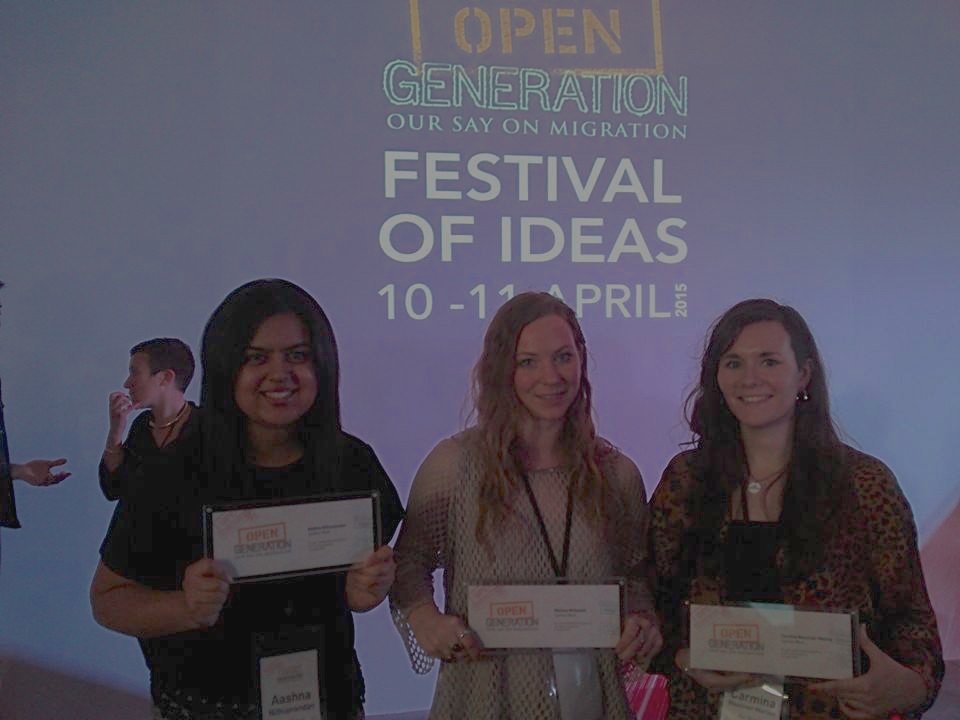
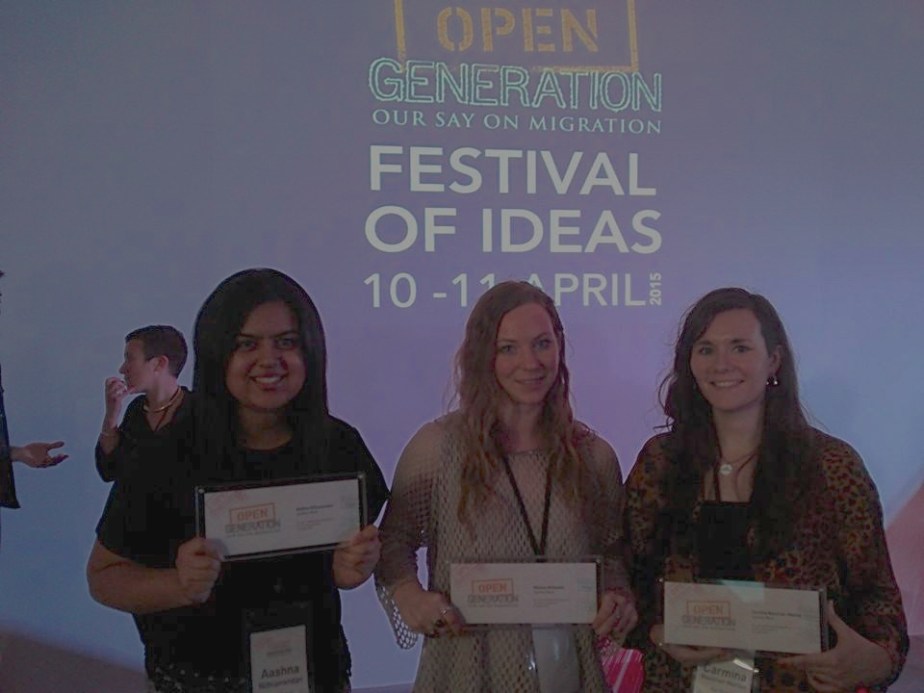
Last weekend I took part in the Festival of Ideas as part of Open Generation, a project which saw spoken word artists, photographers and film makers come together to having our say on migration, in partnership with the Migrants’ Rights Network. I’d been mentored by Joelle Taylor, who has helped push me to practice and memorise my poems more, as well as help with confidence and performance preparation techniques. The day started with an early morning meeting, which meant I was able to stay for the two hours of TEDx Salon about free movement and saw some great talks with discussion at the end.
I went to one of the talks during the rest of the day called ‘Redefining Britishness’, I went to a workshop by Adam Kammerling, and got a bit of rehearsal time with fellow poet Melissa McDonald (who’s only done six performances and is already making waves!) There was so much inspiring stuff going on – too much to regurgitate here, but hopefully some videos will go up and I can share them another time.
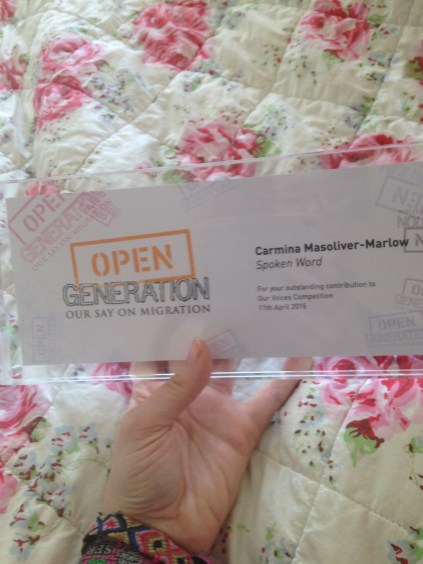
We all got a plaque for taking part; there were prizes for each category, and I was lucky enough to win one. I was very pleased to purchase a tripod and some other bits from The Flash Centre, with some very generous vouchers. I will also be headed to The Dorchester’s China Tang for a birthday meal with my boyfriend, thanks to this. I admit, I initially felt uneasy about it being a competition, but it is nice to get this kind of recognition. I put the tripod to use this week at She Grrrowls and it made it so much easier… once I’d figured out with a couple of others how to put it up! Plus, having a luxury dim sum meal on my birthday makes up for all the soups and sandwiches you end up eating to find something cheap as a poet.

My poem itself was based on a Congolese woman who was raped, used as a sex slave, and then came to the UK to be detained at Yarl’s Wood. It was inspired by this Guardian article by Natasha Walter. I have known about these atrocities for a while and it was hard to write a poem without acknowledging the frustration that I too have a part to play in them, but thankfully more is being done to source conflict-free minerals (see Intel), yet we must still raise awareness. Poetry Meets Art is an event that does this, hosted by a wonderful woman called Emma Ako. I asked Emma for some places to share with people around this topic, so here’s where she suggested:
Save The Congo
Fairphone
Paniz Hospital
Congolese Action Youth Platform
Mothers of Congo
Enough

Carmina is performing at the sold out ‘Open Generation’ event.
After mentorship by Joelle Taylor, she will be performing a new piece connected to Migrants’ Rights and will be involved in a Q&A related issues brought up in her poem.
It will be hosted by Adam Kammerling.
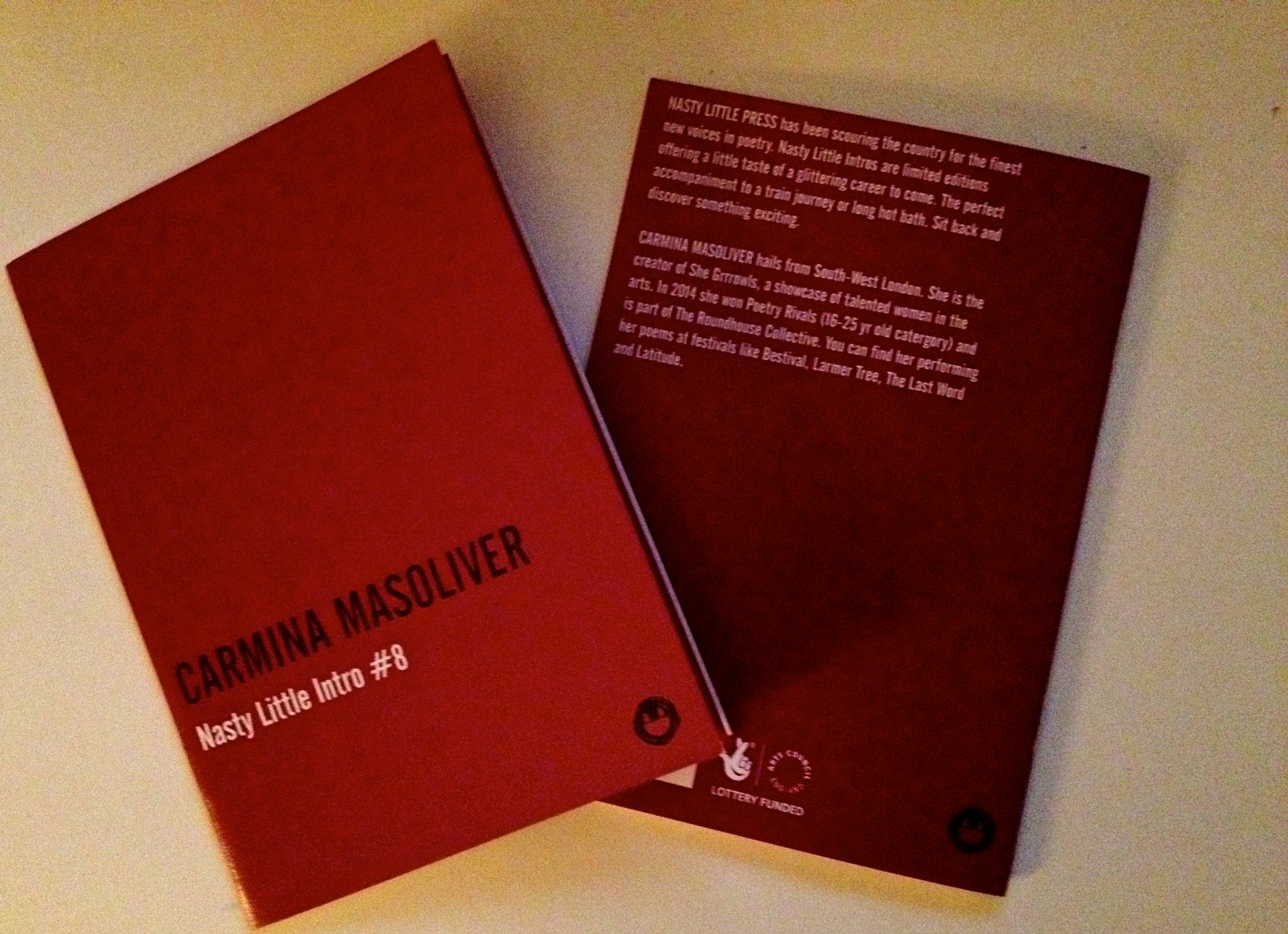
Yesterday I was delighted to see that John Field has reviewed my Nasty Little Intro #8. Last year Field was named one of the top poetry bloggers by Picador, and it was great to see his insight into my poems.

There are still some £2 books available from the Nasty Little Press website, so please do support poets and independent presses alike by buying a copy! Ben Norris has already sold out, so I’ve got some catching up to do – help a gal out! I’d also like to recommend fellow UEA poet Hattie Grünewald’s Intro book. She also does a great brunch blog and updates of her poems on tumblr.
I’m thrilled to announce that my poem Monkey Bars has been published in the Outsider edition of Popshot Magazine. I’ve tried many times over the past six years and I’m finally in there, my poem beautifully illustrated by Paul Garland. I’m a subscriber to Popshot, and I recommend them for having a lovely collection of short stories, flash fiction and poetry. You can see the illustration in details on Garland’s website too, where he offers a great insight into the poem’s meaning.

In case you hadn’t heard, Ideas Tap is facing closure on 2nd June, unless more funding is secured before then. As they have tried already to get more funding, this is obviously not a sure thing. This news came as a great shock to me, and I had taken for granted that Ideas Tap was a new essential to the picture of the arts today, something that would stand the test of time.
Sabrina Mahfouz has set up a campaign to save Ideas Tap from this terrible fate. A fate that highlights the reality of the arts today, a landscape where funding is constantly being cut, and a government that often devalues the arts, evidenced by these cuts.

Please join the campaign and do anything you can to spread the word, in the hope that funding can be secured for the future. Share this post, make your own, and continue to show yours support the arts in any way you can.
Join the mailing list and Facebook Page and follow on Twitter, and tweet using the hashtag #LoveIdeasTap. Become a supporter and find out more about what you can do to help.
It’s been a long time since I wrote my poem Paradise, and nearly a year since I won first place in the Poetry Rivals competition. The poem was inspired by the No More Page 3 campaign, placing judgement on society, the newspaper, and not on the models.
Thanks to all those involved with Poetry Rivals, including host and mentor Mark Grist, judges Hollie McNish, Mixy and Tim Clare. A massive thanks to those at Poetry Rivals HQ who have had to put up with my emails, drawing out the filming with ideas of parks, fish and chips shops and newsagents. There was a moment where my local newsagents from my childhood may have been involved, but to my relief, they stopped responding (more on that when I write my one woman show!) Thanks also then go to the Roundhouse for being able to film the poem there. Lastly, a big thanks to Guy Larsen for his fantastic filming.
If you liked this poem, please buy a copy of my poetry pamphlet from Nasty Little Press. There are other poems too, and you might like them. It’s signed, limited edition and just £2. Themes touch on topics such as multiculturalism, education, love, the pursuit of happiness and having a digitally native childhood. Or else come to a gig; my next performance is at the Festival of Ideas as part of Open Generation on Saturday 11th April. I’ll bring some books along so you don’t have to pay P&P.
I’m currently typing up notes from BARcademy, a writing and professional development week with Burn After Reading that took place in August 2014. That was 6 months ago. There’s a little indication of how my life is going.
So, I think it’s about time to have a look at the previous year and what I’m currently up to. One of my greatest achievements of 2014 (and my life) was being published by Nasty Little Press, and this was followed by an incredible summer of performing at a total of five festivals. I performed at Latitude, Secret Garden Party, Camp Bestival, In the Woods and Bestival. I also managed to fit in a sneaky four day holiday to Spain. I was ill for at least three weeks because of all this activity – just in time for the new term at work. I graduated from the Roundhouse Poetry Collective programme and formed Kid Glove. We now have a logo too – designed by Matthew Dickerson. We’re currently working a Twitter and a website… and on a show about adventure! This will be scratched at the Roundhouse’s Last Word Festival on Sunday 31st May at 1.30pm. Tickets are free, so book yourself a spot now. We’re resident artists at the Roundhouse this year, which is really cool.
This year has seen a bit of success so far (though I would like to be booked for more features, please). I am delighted to have had a poem accepted into Popshot Magazine! This will be available from 1st April and I’m thrilled to be in it after a lot of submissions in the past. I have also filmed my ‘Paradise’ poem with Guy Larsen, and I’m currently waiting to see it and show it to everyone, which should be by the end of the month – exciting! I will also be working with Joelle Taylor to produce a political poem in the run up to the election, which will be performed at the Festival of Ideas 2015 as part of Open Generation on Friday 10th and Saturday 11th April.
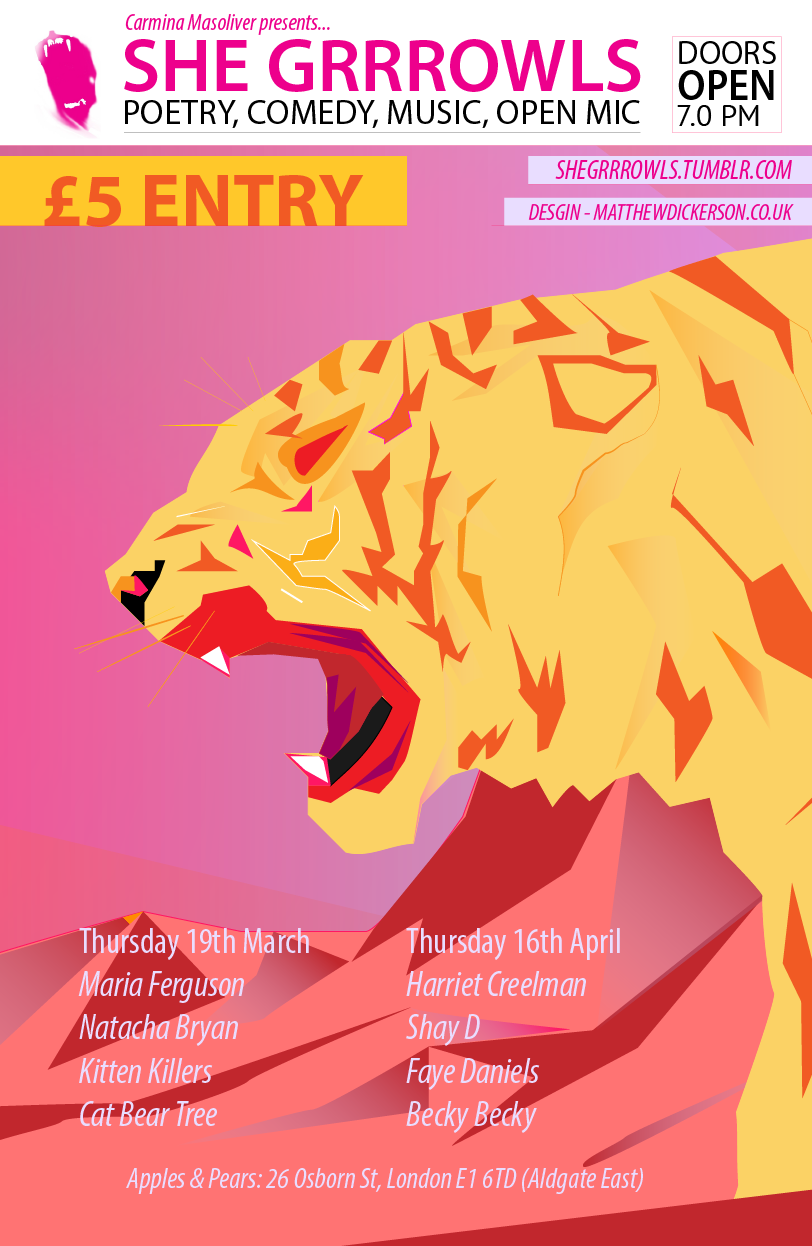
Lastly, make a note in your diaries for the next She Grrrowls event, taking place at Apples & Pears on Thursday 19th March. It will feature Maria Ferguson, Natacha Bryan, Kitten Killers and Cat Bear Tree. Join the event here. Please support these next two events – if we get a good turn out we will be able to confirm the next few months.
Changing Families and Feminist Blind Spots: Have female-friendly policies been captured by middle class feminists?
When giving up an evening to go to a talk on with the title above, you would probably be fair in making the assumption that this would be a discussion amongst identifying Feminists, with a focus on intersectionality, touching on issues of class and race. Or at least that is the assumption I made, when invited by a colleague. It is only now that I read it another way; ‘feminists’ here are The Other, separated from everyone else.
It began with a presentation by Professor Baroness Alison Wolf, yet throughout the evening, it seemed that she was most concerned with promoting her book ‘The XX Factor: How Working Women are Creating a New Society’. If Wolf was meant to be the spokesperson for Feminism, her voice was not strong enough, and she often put her foot in her mouth. For example, when making the assumption that the room is full of middle class people, what are you then saying about working class people? By making a sweeping generalisation on the audience appearance, Wolf was unable to address the complexities of class as it is now. She talked about 15-20% percentage of women being highly educated, and the rest being ignored by Feminism, which may be true of certain strands of mainstream Feminism, but within that she ignored the gap between herself and a lot of women who would be deemed middle class. The middle class is a wider demographic that Wolf presented.
When Wolf began her presentation, she was aware that it may be seen a controversial. At first I wondered if what she was saying was deliberately done to make us feel uncomfortable. That would have been a great tactic. However, as she went on, what she said seemed more illogical and simply not that well informed. She may know her economics, but she doesn’t know her Feminism. I’ve followed the work of The Crunk Feminist Collective for some time, but there are plenty of examples of intersectional Feminism and no mention of this aspect of Feminism today at the event. There are also writers such as Bridget Minamore and Chimene Suleyman writing for Poejazzi who touch on these topics. Here you can read articles such as ‘The “Fierce” Black Woman Inside You Desont’ Exist” (Minamore) and ‘Fighting against the fetishisation of women, doesn’t work if you fetishise women’ (Suleyman), which are Feminist, and offer a valuable critique of the type of Feminism Wolf was attempting to address.
Wolf’s point about working class women was lost by ignoring the women she claimed to be speaking for. But why was she speaking for them at all? Would it not have been better to actually bring women who identified as working class and allowed them the space to get their voice heard? Instead, Wolf presented a case of topics that mainstream Feminists were concerned about and put them up against what was happening elsewhere in the world. However, there was only one example that actually included a gendered news story, and if we are talking on Feminism, this should have been the focus. What was also concerning was the way Wolf talked about rape, which was extremely dismissive. She even went on to say that people are interested in rape because society is obsessed with sex and violence. She seemed not to realise that rape is not about an obsession with sex, but more about power.
Furthermore, women are arguably more vulnerable to rape if they are from a lower economic background or if they are not white, with these factors also being an influence on what happens in the courtroom, should it be taken there. But there was no mention of this, no mention of rape as a weapon of war in places such as the Democratic Republic of the Congo, and I’m not sure there was even mention of the 200 Nigerian girls who were kidnapped in April 2014. Four girls who escaped said they had been held in a camp in Cameroon and raped every day. And she claims that our concern about rape is so we can “feel victimised and superior at the same time.” . The media may have their own agenda, but to imply that we don’t care about these issues just doesn’t make sense.
Mainstream Feminism needs to take notice of how gender, class and race intersect, but this didn’t seem to be exactly what Wolf was saying. She didn’t engage with the role of the superrich 1%. She seemed to want to show that women’s progress has damaged women, and a lot of her argument was based around the idea that a childless woman is a “problem”. Whilst I agreed that more collectivist methods are needed in order to benefit working class women, she spoke of an “individualistic and career-orientated elite” and didn’t really consider who the elite actually are. She made the mistake of criticising others, whilst not looking at her own faults, and including herself in the problems of Feminism, and showing ways in which we all can listen to the voices of working class women.
In the audience, there were stifled noises of exasperation. But if we thought that was bad, we hadn’t seen anything yet! Belinda Brown was next to speak, and she certainly didn’t offer the critique we may have imagined. She spoke about gender trumping class, and didn’t seem to understand the point of intersectionality, that Wolf had touched on by stating that in terms of the pay gap, gender only becomes an issue for those who are from a lower economic background. Whilst this in itself is debatable, this widening gap is a concern; it is a Feminist issue. Brown spoke about women at the top damaging men’s jobs, but it was when she made a joke about women spending money shopping that I was sure that I wouldn’t agree with a word she said.
To be fair, she touched on one point of common ground. Women who have children are obviously biologically forced to take some time out of work to have children. We shared the view that part of the problem is that, where women are the main caregivers, this work is not valued as work. Because society doesn’t value a lot of the work women do, both at home and the type of positions women tend to take, this means that they also face the brunt of financial problems. Yet, because Brown was clearly anti-Feminism, she was also unable to see that men are also the fathers of their children. She repeatedly failed to acknowledge this, and therefore didn’t see a way of this changing. She didn’t see that a more equal distribution of childcare was needed. She didn’t see that this is an issue that runs deeper than class, that middle class families are also struggling to afford childcare, that this is a massive societal problem. Brown became flustered when confronted with the slightly bit of opposition (and believe me, a lot of people held back saying anything), and she brought her personal life as a carer for her partner. Whilst I couldn’t fail to feel sympathy for her situation, I also wanted to (metaphorically) shake her. It didn’t make sense that she could see how the value of her carework is seen as lower than her academic work, and yet couldn’t see that this view is due to the patriarchal structure of society. She couldn’t see that this also links to other power structures such as Capitalism and historic white supremacy.
The whole evening was such a mess that even the chair, Emma Barnett, had to step in to confront what was being said. Frankly, I would have rather listened to what Barnett had to say than either of the actual speakers.
Ellie Holland is a news reporter for series 7 of London360 – a show which uncovers the hidden voices of London’s communities. She came to She Grrrowls in the summer to feature some of the show and interview me. You can find me discussing my poem ‘Risk’ on her YouTube channel, and Rowena Knight, one of the loyal volunteers at She Grrrowls, performing her poem ‘Garlic’. At our meeting, I found out more about Holland’s specific interest in gender and burlesque, which you can find out about on this Huffington Post article.
“If a friend made a rape joke in your presence, what would you do? Carmina Masoliver, who runs spoken word and poetry event She Grrrowls, reveals her experience.”
Lastly, you can also hear me talk on October 6th show for London360, 8.38 minutes in.