04.07.15 – The Fling Festival

Trauma Genes

I’ve had the honour of being part of Sammy Brough’s ‘Trauma Genes’ Home Cooking Podcast, which you can listen to here. I was interested in the topic as it made me think of Dr Joy Leary’s research on Post Traumatic Slave Disorder, below.

My poem was based on research that I amalgamated in poetic form, using first person, and a ‘telephone’ sound to give a sense of distance to reinforce the idea of trauma being passed through history.

On 1st June, I performed a piece I wrote for You Press on a project called ‘Voices of Redemption’, where artists were paired with ex-offenders to tell their story. My particular story questioned the line between victim and perpetrator, and although I didn’t realise this would be a common theme, it was surprising to see the amount of injustice within the justice system. Yet, I also wanted the poem to recognise the crime committed, to move on from that, and other than impacting the audience, I wanted the person I was paired with to get something positive from the experience. It was a challenging project, simply because it is quite daunting to have someone else’s life and write a poem about it. There’s a recording of the previous project ‘One Story: Our Voice’ I was involved with, and I hope this will also be recorded as it was such a unique and important event.

IMG_7314

I have also performed at The Last Word Festival with Kid Glove at The Roundhouse. It has been a long and difficult few months building up to the show, and we’re yet to decided where we will take the show. Practically, it may be unrealistic to be able to perform it in the way we may have had in our mind at the start, but it has been a massive learning experience and I think we accomplished a great scratch show in the end, being such an ambitious project. I mean, one of us lives in Germany! I think everyone deserves a massive pat on the back for pulling it off and I’m sure we’ve all learnt a lot about ourselves from it.

I’m reading a few books at the moment – one that stands out is The Ice Cream Empire, by Kit Poulson, and it very much reminds me of the writing from ‘Dear Adventure’ and has made me think that we could do something with text, or even sound, as a way forward with the show idea. I’ve also been listening to a few things on the radio…

1. BBC Radio 1Xtra are doing special features on poetry/spoken word and some of my fellow poets have been involved so far. Hopefully more on this later!

2. The Love Song of J Alfred Prufrock has been featured on BBC Radio 4 and features lovely people like Kayo Chingonyi and Emmy the Great.

My next performance is at The Chocolate Poetry Club. Thank you to the mystery person who recommended me. I’ve only had one other paid gig this year, so it really cheered me up to have this to look forward to!

Open Generation: Migrants’ Rights

11150320_10152668575465755_4441906171216382262_n (1)

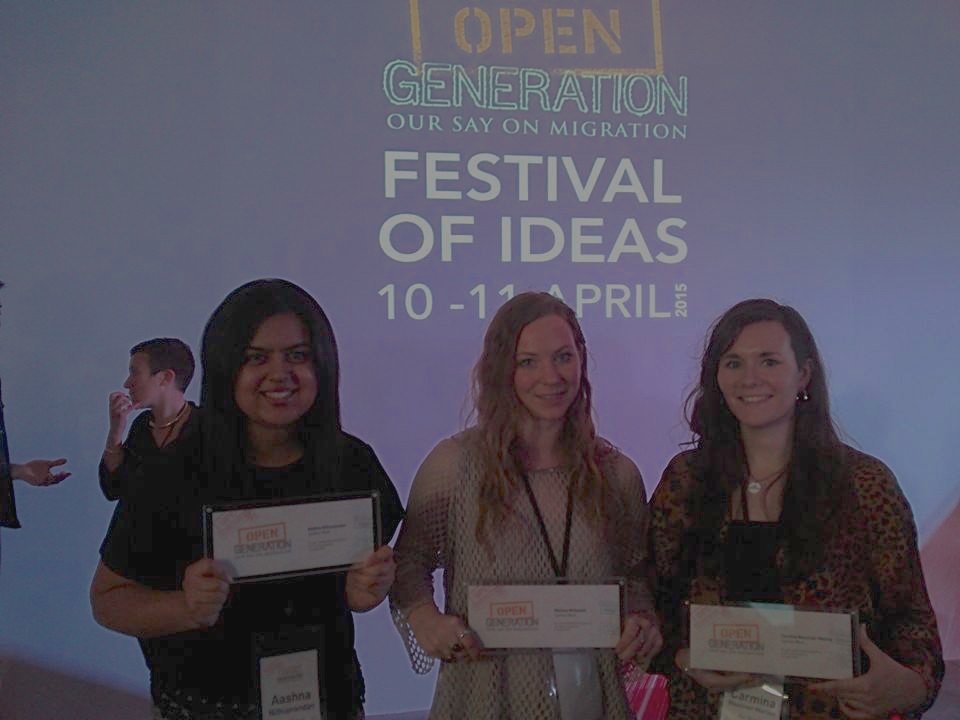
Last weekend I took part in the Festival of Ideas as part of Open Generation, a project which saw spoken word artists, photographers and film makers come together to having our say on migration, in partnership with the Migrants’ Rights Network. I’d been mentored by Joelle Taylor, who has helped push me to practice and memorise my poems more, as well as help with confidence and performance preparation techniques. The day started with an early morning meeting, which meant I was able to stay for the two hours of TEDx Salon about free movement and saw some great talks with discussion at the end.

I went to one of the talks during the rest of the day called ‘Redefining Britishness’, I went to a workshop by Adam Kammerling, and got a bit of rehearsal time with fellow poet Melissa McDonald (who’s only done six performances and is already making waves!) There was so much inspiring stuff going on – too much to regurgitate here, but hopefully some videos will go up and I can share them another time.

IMG_2970

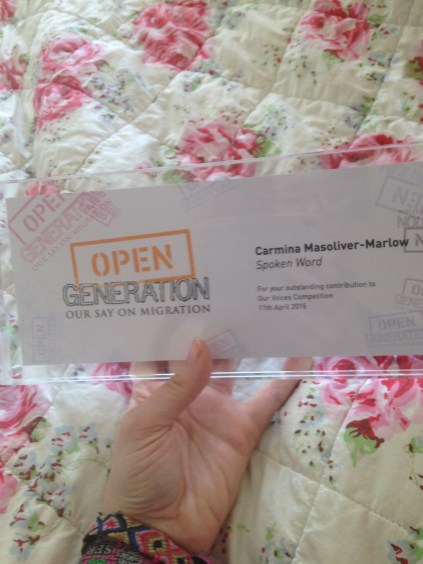
We all got a plaque for taking part; there were prizes for each category, and I was lucky enough to win one. I was very pleased to purchase a tripod and some other bits from The Flash Centre, with some very generous vouchers. I will also be headed to The Dorchester’s China Tang for a birthday meal with my boyfriend, thanks to this. I admit, I initially felt uneasy about it being a competition, but it is nice to get this kind of recognition. I put the tripod to use this week at She Grrrowls and it made it so much easier… once I’d figured out with a couple of others how to put it up! Plus, having a luxury dim sum meal on my birthday makes up for all the soups and sandwiches you end up eating to find something cheap as a poet.

My poem itself was based on a Congolese woman who was raped, used as a sex slave, and then came to the UK to be detained at Yarl’s Wood. It was inspired by this Guardian article by Natasha Walter. I have known about these atrocities for a while and it was hard to write a poem without acknowledging the frustration that I too have a part to play in them, but thankfully more is being done to source conflict-free minerals (see Intel), yet we must still raise awareness. Poetry Meets Art is an event that does this, hosted by a wonderful woman called Emma Ako. I asked Emma for some places to share with people around this topic, so here’s where she suggested:

Save The Congo
Fairphone
Paniz Hospital
Congolese Action Youth Platform
Mothers of Congo
Enough

Popshot Publication!

I’m thrilled to announce that my poem Monkey Bars has been published in the Outsider edition of Popshot Magazine. I’ve tried many times over the past six years and I’m finally in there, my poem beautifully illustrated by Paul Garland. I’m a subscriber to Popshot, and I recommend them for having a lovely collection of short stories, flash fiction and poetry. You can see the illustration in details on Garland’s website too, where he offers a great insight into the poem’s meaning.

Poetry Rivals 2013/14 Winner: Paradise

It’s been a long time since I wrote my poem Paradise, and nearly a year since I won first place in the Poetry Rivals competition. The poem was inspired by the No More Page 3 campaign, placing judgement on society, the newspaper, and not on the models.

Thanks to all those involved with Poetry Rivals, including host and mentor Mark Grist, judges Hollie McNish, Mixy and Tim Clare. A massive thanks to those at Poetry Rivals HQ who have had to put up with my emails, drawing out the filming with ideas of parks, fish and chips shops and newsagents. There was a moment where my local newsagents from my childhood may have been involved, but to my relief, they stopped responding (more on that when I write my one woman show!) Thanks also then go to the Roundhouse for being able to film the poem there. Lastly, a big thanks to Guy Larsen for his fantastic filming.

If you liked this poem, please buy a copy of my poetry pamphlet from Nasty Little Press. There are other poems too, and you might like them. It’s signed, limited edition and just £2. Themes touch on topics such as multiculturalism, education, love, the pursuit of happiness and having a digitally native childhood. Or else come to a gig; my next performance is at the Festival of Ideas as part of Open Generation on Saturday 11th April. I’ll bring some books along so you don’t have to pay P&P.

Women and ‘Banter’: What are her choices?

Ellie Holland is a news reporter for series 7 of London360 – a show which uncovers the hidden voices of London’s communities. She came to She Grrrowls in the summer to feature some of the show and interview me. You can find me discussing my poem ‘Risk’ on her YouTube channel, and Rowena Knight, one of the loyal volunteers at She Grrrowls, performing her poem ‘Garlic’. At our meeting, I found out more about Holland’s specific interest in gender and burlesque, which you can find out about on this Huffington Post article.

“If a friend made a rape joke in your presence, what would you do? Carmina Masoliver, who runs spoken word and poetry event She Grrrowls, reveals her experience.”

Lastly, you can also hear me talk on October 6th show for London360, 8.38 minutes in.

06.11.14: Bixtongue

EFFRA SOCIAL

BRIXTON SW2 1DF

10606107_301277056744896_3020573914221899257_n

Norwich Love – from Art in My Mouth to the Waterfront

I have spent a few days with my boyfriend in Norwich. I read and wrote, and memorised and recorded poems. On our day off we went for a Chinese buffet, and went to an art gallery and to see a band. Here are some photographs from Moosey Art’s exhibition at Stew Gallery, Art in my Mouth. I really recommend checking out all the artists and the work is really affordable, so I really hope some people get behind these guys.

IMG_2561IMG_2567


Funnily enough I saw someone post something on Facebook about the coins above. Check out the Tales You Lose page to find out more and see some of the other designs.

These pineapples are only £30 each! I really want one… but then, you can’t really just get one can you? They look so scrumptious, I’d love them to go up in my house, if I ever move out of my parents’ house! The wall below was completed as part of the live art they had at the opening night. IMG_2563 IMG_2566

IMG_2573

That evening I had booked tickets for Annie Eve the day before. I felt like we were a bit of a rubbish audience, as everyone seems too shy to come forward and lingered at the edges the whole night. Matt’s house is quite a walk from the city centre, so we were quite happy to follow suit and sat on the floor for the gig. Matt spoke to the support act that we saw, and so we think this was Norwich lad, George Cheetham (and not Harry Edwards, whose name was also on the line-up). He was a great support act, with loop pedals and tricks up his sleeve in the form of a harmonica and melodica. He was a bit too self-deprecating at times, but he mostly appeared confident and friendly.
IMG_2576

Whilst Cheetham had fully enunciated his words, my only criticism of Annie Eve would be for her to open her mouth wider so we could hear her beautiful lyrics more clearly. Cheetham’s words were very clear, but with lyrics such as ‘she’s as drunk as a skunk’, they didn’t have the emotional depth of Annie’s. Still, I think it’s great that he played both old and new material, and with tales of working in shops and taking five years to make his album, he seemed like a pretty inspirational guy. So, with that in mind, I felt like my ears were straining to make out the words Annie Eve was singing, which hindered my enjoyment a bit. However, I was really glad to see her live, and she can only grow as a performer, which her change between acoustic and electric shows. Maybe with time and more confidence and experience she will sing more clearly, as I really think her lyricism is a big part of her appeal. I’ve given a few hints to Matt to get me her album, so hopefully he will take note – and hopefully it will contain lyric sheets (my main reason for still wanting to buy CD albums). Click below to view her song ‘Ropes’ on YouTube.

Feminism in London Conference: Part 4

IMG_2543
At the end of the conference we gathered for the final speeches and the Emma Humphreys memorial prize giving. Much of it was very moving, as well as being informative on some of the work that is happening with regard to violence against women. I didn’t feel it packed a punch in the way that other moments of the day had for me, but this was probably just because the opening talk had been so important and eye-opening for me. Along with the talks on shadeism and men’s role in Feminism, I’m now looking to build upon areas where there are gaps in my knowledge and experience, as opposed to reinforcing what we already know. That said, it is always needed to rally up support with speeches like this where there is a resurgence of energy, to keep us going, to keep us fighting.

I also really enjoyed Sabrina Mahfouz’s poem, which incorporated different parts of the day that she had experienced. Possibly out of paranoia, I had been wondering why I was not seeing the successes of some other poets, and worried that maybe I have been to vocal about my views, that I was being labelled to extreme. In person, I have faced little opposition, but still some opposition, to She Grrrowls – I’ve been told that the logo is scary and off-putting, that I’m creating a problem in what is already an equal community, simply for featuring women in the arts at my event. So, it really helped me to see Sabrina Mahfouz up there, proud to be a Feminist, yet also managing to be an extremely successful poet, amongst other things. Since feeling this fear that I would be jeopardising my career by being so outwardly Feminist (a fear that was expressed in the conference to explain why women would not use the label), I cannot express fully my gratitude at seeing Mahfouz take to the stage and be involved in the Feminism in London conference.

IMG_0073IMG_0074


After the conference, we headed to the SU bar for the after party. I was joined by Rose Swainston and Maeve Scullion (pictured above) to represent Kid Glove. Kate Smurthwaite was also featuring; I mentioned something I found problematic in my earlier post, but other than that, she was the performer I most enjoyed that evening. I also enjoyed the other poetry act, Mabel, and the women who sang Spanish and English songs on her guitar. I felt proud after knowing ‘mujer’ meant ‘woman’ (sadly, due to Duo Lingo, not my Spanish heritage). Without wanting to dwell on negatives, I was really taken aback by a woman who, after a poem on personal experience of a rape-joke, called out ‘I’m not clapping to that, it was awful.’ And soon after, said to another woman ‘are we going?’ She was very near the stage and she didn’t try to hide what she was saying – quite the opposite. I felt close to tears, but as we were rotating poems between the three of us, I had to put it to the back of my mind and tell myself she must not have understood the poem. I stayed for a bit of the Stepney Sisters, but left early as I was tired and had a long journey to go back to the suburbs. I’m already looking forward to next year’s conference and wonder where I will be on the journey of Feminism then.

IMG_2548IMG_2549


Feminism in London Conference 2014: Part 2

Parts 2 and 3 deal with the morning and afternoon workshops that I attended at the Feminism in London Conference, which were on Shadism and Men’s role in the Feminist movement. In the first workshop I wanted to learn from the experiences of WoC (Women of Colour). As I am White European, I didn’t feel I needed to relate any experiences, despite the encouragement from Femi that all people present should speak if they wanted. Sure, I may have had things to say about friends, and about how having a Spanish name and curly hair has coloured my experiences, but I just didn’t think what I had to say was of that much relevance in such a short space of time, other than reinforce the points that were already being made in connection to shadism. I mostly listened, and only commented at the end when I urged people to help with the education, suggesting the TES website as a place to upload texts that could be read for English that deal with issues of race and gender etc. As again and again education is highlighted as being so important in opening a dialogue on these issues, I feel I am currently in such a privileged position and I need to take action.

Just to start off, in case you aren’t aware of what shadeism/shadism means, then I’ll give a quick definition. It is the discrimination of individuals based on skin tone, which can be both intrinsic and extrinsic to the race or community. It is heavily connected with the false perception that the closer an individual’s skin is to white, the more superior they are to other members of their race. It is something steeped in historical oppression, and often connects to class and other issues. Its place within the conference is also due to the fact that it often relates more strongly to women, due to the pressures of beauty standards. A film exploring just one aspect of this issue is the documentary ‘Good Hair’, presented by Chris Rock, which I saw a few years ago and was mentioned during this workshop. You can watch the trailer below… although it’s advertised here as a comedy, it’s definitely mixed with a whole dose of tragedy as humour is used to explore something that really is no laughing matter. [Edit! My friend, Natalie Cooper, drew my attention to the fact that ‘Good Hair’ is actually a rip off of ‘My Nappy Roots‘.]

Some of the points that were raised included (text in brackets shows my own points):

-The need for colour-blind casting in schools and in the wider world of acting.
-Comments on hair and touching without permission.
-Stereotypes: people saying they do not “sound Black” or white friends saying they do not think of them as Black.
-Older relatives handing down bleaching cream to young children.
-Members of the family being treated differently due to skin tone.
-The importance of language. It was strongly felt that to label oneself Black and have pride in that was vital in making a political statement.
-In a similar vein, it is up to the individual whether to a mixed race person identifies as either Black or White. This connects to people picking out features that go into either category, and it was asserted that it should not matter, should not be asked.
-The importance of encouraging girls to keep their hair natural until old enough to make an informed decision.
-Self-hatred is an important issue, which is why it is important to still tell young WoC that they are beautiful.
-WoC need more visibility in the media, advertising, in high street shops etc. (To ignore beauty and consumerism is a privilege.)
-The fascination with White people wanting to be tanned. It is that they want to be darker, but do not want the problems that come with being a WoC. White people need to understand the politics of bleaching is very different to wanting to tan. (However, seeing a mixed race tone as the ideal is problematic in terms of it perpetuating shadeism.)
-There are assumptions that Black people don’t care about appearance, when statistically they spend more money on this.
-White people should be able to describe someone as Black, yet it was also noted that this should not be to the extent that these White people do not see anything else.
-Stickers on things such as bleaching or “lightening” products (it’s the same thing, people, which is why I was disgusted at a poster I saw at a sk:in clinic). Consciousness raising.

By the end, it felt like we had only tapped the surface of shadism. We tried to conclude things, to come up with solutions and action plans, but each time women would return to speak more about their experiences. I don’t feel it is my place to even do more than share this list of points, but I hope that this post will be informative for white people, and that WoC who were unable to attend may be able to voice their own experiences and open up discussion, between friends, family and online platforms etc. Lastly, I have since come across an article by Victoria Bond which stated something that resonated with me: race is a spectrum, not a dichotomy.