Blog

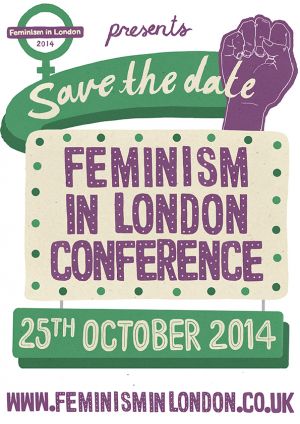
Feminism in London Conference: Part 3


Feminism and men: Working Together for Gender Equality?

Sandy Ruxton and Nikki van der Gaag

For this workshop we were shown a presentation and then got into groups to discuss different questions.

What’s improved?

Thankfully Feminism has done some positive things over the years. There have been changes within the legal system (though still far from perfect), women have the vote (although not in Saudi Arabia), girls’ access to education has improved generally, and in turn women’s employment prospects. These progressions can be why some people think we are equal already. Women and girls have changed a lot, whilst men and boys have not. There is not one country that has achieved true equality yet, and current rates of progression suggest that it will take 95 years to achieve gender equality according to the UN.

What still needs improvement?

Everything that has improved is still not perfect. One of the biggest problems stopping further progress is a culture of sexism and misogyny, all too clear on the web, but, equally prevalent offline. Violence against women is still a big global issue, and along with this is the maternal mortality rates in the developing world. Women do a majority of care work, which is often unpaid. One way to move forward would be to gain more political power; although having women in power doesn’t necessarily mean that women’s issues will be put at the forefront, it would be a massive step forward. Along with this, the glass ceiling still exists when it comes to women moving up the career ladder.

Examples of Men’s Involvement:
He for She
UNFPA, CARE
Instituto Promundo and Sonke Gender Justice
MenEngage
Men Care

What does men’s involvement not mean?

-It does not mean shifting the focus away from women and girls.
-It does not mean men are less powerful than women (Men’s Rights Activists tend to express the view that women are now more dominant).
-It does not mean men should lead on gender issues, but rather that they are standing besides women and supporting them in the fight for gender equality.

The European Context

Ruxton has focused on Europe, and so he delivered some information about the context here. He noted the impact of the financial crisis has in turn seen a rise of right wing populism and racism. One big issue is sexual exploitation and again, the cultural landscape of patriarchal dominance.

Problems:

-Men may be apathetic or resistant to change, either from benefiting from patriarchy, or being in denial.
-Men’s Rights Activists can be hostile towards women.
-There can be a distraction from support for women.

How to encourage men to get involved:

-Men obviously need to see that there are benefits for men too. Sadly, talking solely about women can lead to defensive attitudes.
-The diversity of men’s experiences needs to be taken into account e.g. class, race, mental health issues.
-A focus on opportunity moments in men’s lives and what they can do practically.
-Assertion that gender equality is right in terms of a a wider concept of social justice.
-It is important to address real problems that men experience and open a dialogue.
-It is vital that alliances are built with women and women’s groups (to avoid being an MRA).

Examples of ways men can get involved:

-Individual acts.
-Through education e.g. Great Men Value Great Women.
-Caring for children.
-Anti-violence programmes e.g. White Ribbon.
-Involving men at senior levels in organisations.
-Government initiatives.
-Thinking internationally.

Now for the group discussions…

Unlearning patriarchal masculinity:

Due to traditional gender roles being part of the patriarchy, it is important that men do not take over what women are saying due to their position in society. A good point to focus on is that these gender roles exist for both men and women and that this is a problem as it restricts us all as humans. This was the first discussion group feedback that highlighted the significance of education, and it was not the last. It was stressed that fatherhood is a key time to communicate and pass on an awareness of notions of masculinity in a way that deconstructs the norm. This group commented on different models of power, and that questioning and challenging problematic views was better than being defensive. This was also noted with regard to group situation. The difficulty of this was noted due to the fact that men are often the beneficiaries of the patriarchy.

Obstacles:

The desire to conform was highlighted as a big obstacles, as well as the idea that it is often not seen as a men’s issue too. This also goes in hand with education about Feminism and why it is important to keep the label. One of the men in the group disagreed that Feminism was something that needed “selling”, but perhaps this isn’t reflected in the opposition that women and Feminists are often faced with. It may be a sad fact that we do have to be aware of how we package it. The concept of the invisibility of privilege was also discussed (which also reinforces the idea that we need to present Feminism in an accessible way).

How can we foster men’s involvement?

Some of the ways to do this came up in the discussion on obstacles, but again, engaging different groups of men was stressed, and doing so in cross-disciplinary ways. A method of engaging men from a young age, or even with those with an outdated view of Feminism, would be to find the language to engage with them without the barrier of the label and then saying ‘hey, well that’s Feminism!’

What actions can men take?

I was in this group and I ended up speaking first from a personal experience where I had felt silenced and wished I had the support from my boyfriend and male friend. Whilst we all agreed speaking out against sexism and misogyny was integral to the fight for equality, it was also seen as important to think about barriers that stop men from doing this, such as the need to conform. It was also highlighted that we needed to eradicate the association of guilt and shame with inequality; it is not a case of men vs. women, and individual men need not take on the burden of representing the patriarchy, but should instead unite against male dominance in society for a more egalitarian environment. Again, an education of Feminism both past and present is a a vital way to take action. A focus on positive actions is needed in order to go with this idea of rebranding Feminism, so that it is not misunderstood, as it often is. Again, there was an emphasis on joining men’s groups with women’s in order to form alliances.

Additional Comments:

Some books were mentioned, including ‘Tackling Macho Values’ and ‘Why Some Men Hurt Women and How Some MenCan Help.’ Some final points were noted about men believing we have equality and having a confusion about Feminism, and with that not making men feel like they are the enemy just because they are ignorant to this. Anger was brought up and there were mixed views on the impact of anger, with some men saying that it could be off-putting, whilst others showing an understanding that it a normal reaction to injustice. A woman commented that anger comes from a position of powerlessness and so it is important to recharge by coming together with like-minded people to talk about these things. It can be exhausting going to yet another boyfriend and explaining why you’re a Feminist and why he should be too. I thought that anger is sometimes inevitable, but it is important to hone these feelings of upset and anger. So, instead of it taking its toll on personal relationships, you can make videos and blog posts about these issues. Then you can show others what you think in a more articulate way than within arguments that make occur spontaneously from conversations on gender equality.

I felt close to tears, but as we were rotating poems between the three of us, I had to put it to the back of my mind and tell myself she must not have understood the poem. I stayed for a bit of the Stepney Sisters, but left early as I was tired and had a long journey to go back to the suburbs. I’m already looking forward to next year’s conference and wonder where I will be on the journey of Feminism then.

 

04.11.14: Burn After Reading

Burn After Reading Presents
The Seven Dials Club, 42 Earlham Street, Covent Garden
Tuesday 4th November
Doors 7.45pm
£5 on the door

Featuring BAR poets: Amaal Said, Belinda Zhawi, Cameron Brady-Turner, Carmina Masoliver, Rena Minegis, Safi Strand and Tyrone Lewis.

They’ll be performing alongside our talented feature guests in the form of  Yomi ‘GREEdS’ Sode and Katie Bonna.

25.10.14: Feminism in London After-Party with Kid Glove

Having spent a year being taught and mentored by the poet Bohdan Piasecki as part of The Roundhouse Poetry Collective 2014, we have formed Kid Glove, a collective of poets united by a desire to tell stories, make poetry and perform our poetry around the UK. We write words for both the stage and the page and are interested in ways of developing new practices in spoken word poetry. We like stories that hold mirrors before the audience, words that make you laugh and cry, and images that leave you seeing stars. Four members of Kid Glove will be performing at Feminism in London this Saturday 25th October.

FIL14

Muse Arcade

So, I don’t often share the text of my poems. I tend to put up videos instead, as I don’t want too much text online in terms of rules with publishing and competitions. However, I was invited by fellow Nasty Little Press writer, Hattie Grunewald, to take part in a project called ‘Muse Arcade’, where Scott Woods posted a list of titles as prompts for poems on Facebook. I’ve been wanting to stop writing so much for a while, so I can do more editing and work towards putting a larger collection of work together. That said, I found these titles too tempting to resist, and so I was inspired to write these poems wherever I happened to be… largely on trains. I’m looking for feedback, should anyone wish to give me any. To read it, simply click here.

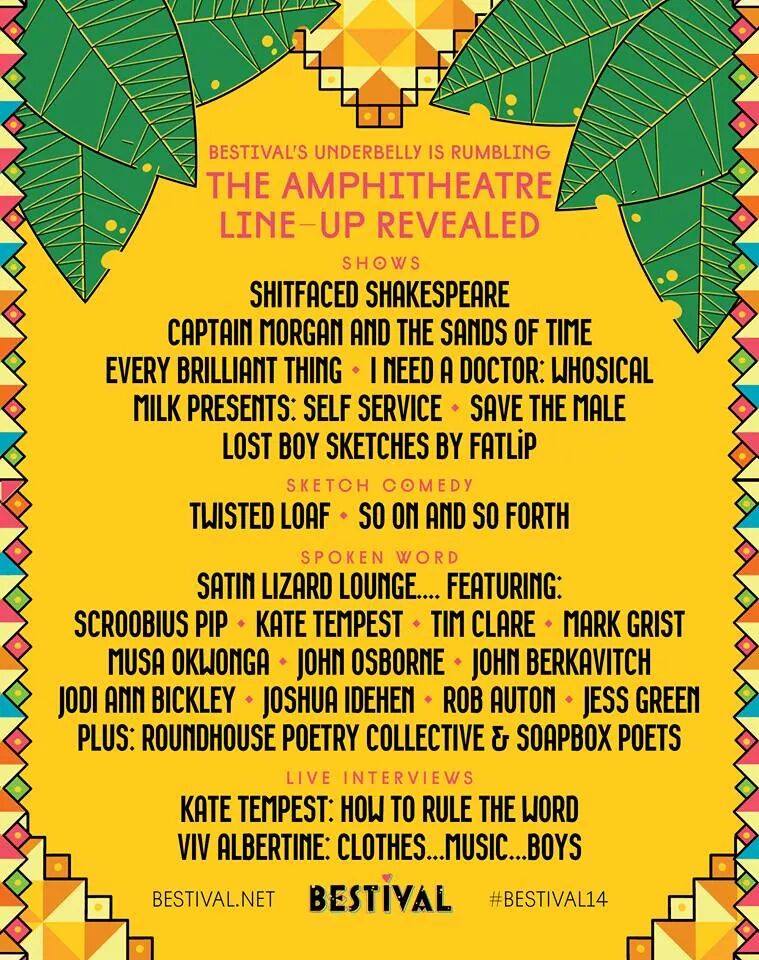
Tell A Story: #1 Desert Island at Bestival 2014

I’ll write a proper update soon. Things are busy. I got ill for four weeks… that didn’t help. I feel like I have to sit down and write a big long post, like, settle down, let me tell you a story with a cup of tea.

Anyway, speaking of stories, while you wait for another long post (because our attention spans are so great, and you love me so much), have a listen to this podcast on Tell a Story. It features myself alongside two other members of the old (old!) Roundhouse Collective, Joel Auterson and Sophie Fenella – and we’re now called ‘Kid Glove’! I hope you like it, because it was a long process.

It also features Kate Tempest, Tim Clare and Scroobius Pip. I wasn’t very good at it; I’m an INFJ (which I just got a book on) and maybe that has something to do with it. I need to be briefed and have time to prepare… hence I’m not on it much! Oh my god, that was literally the only vaguely good thing I came out with.

Not quitting the day job just yet folks. At least I’m educating a few young people on the way.

National Poetry Day

I celebrated National Poetry Day by taking some of my intervention students to NPD Live at Southbank. Then I went to a slam with some recycled poems, plus one from my Nasty Little Intro that I learnt whilst waiting.

I came joint first place in the Genesis Slam (there were only three of us…) Sadly I will have to Skype/send videos in for the final in December as I’m on unpaid leave for an Arvon writing residency (exciting!). I also managed to forget my lines in a poem-song I did because there was a head-to-head to attempt to get a winner, but I took a RISK, and that happens.

I am also very happy about getting fancy cinema tickets for two, plus pie and mash!

Ben Howard: How Not to be an Audience

I wrote this review on my way home, feeling disappointed at Ben Howard’s performance at the iTunes festival, after moaning with my friend, as well as other vocal fans on the way out of the building. We hesitated leaving as he played just 55 minutes of a contracted 70 minute set, which a commenter told me was meant to include two old songs we had been craving.

However, amongst the commenters who agreed, there were a few that disagreed, and some that we very angry over this post. Although I think the swearing and shouty capital letters were unnecessary, I think it is important to admit where you’re wrong. I watched back at I had been wrong about the trace of narcissism I had initially detected. In fact, this had been a projection of my own frustration at not knowing the songs, expecting to be hearing old classics mixed in with the new, and my height meaning I was unable to see most of the time. When I watched back, I saw that the comments I had thought were rude, were actually bordering on the modesty I thought was missing: Howard’s face looked down as he laughed, as if unable to comprehend the crowd. The importance of body language, eh?

I was also wrong about interpreting him sitting down as lazy. I hadn’t seen him perform and was simply ignorant to his musical technique. In fact, the sitting down was to do with the pedals he needed to press. Other than that, my opinion still stands that the gig would have been better with a mixture of music, and with better audience interaction. So, point number (3) is out, but (1) and (2) still stand for me. Nevertheless, the feeling that I and many others got from Howard could well be to do with what another commenter mentioned: ” If you watch some of his interviews he has tough time dealing with fame and expectations, and that definitely showed last night.” I feel very passionate about mental health issues, and I would hate for my negative words to not be sympathetic to that. Perhaps what we saw on Wednesday was a man who was trying to put his all into it, but was simply struggling, having a bad day.

So, all this got me thinking about the audience, and how reactionary lots of people, myself included, had been after the gig. Some of these points were what other commenters brought up, and others were things that are linked to what I had been saying. During the gig, the audience were standing their like zombies, to the point where I was zapped of energy and was infected with the zombie bug too (plus, with the frustration with my expectations not being met). People nearer the front simply stood there, whilst other areas meant that people talked too loudly, seemingly uninterested with the gig. I think would have enjoyed the gig more had I been sat down in a quiet field with the music blowing through the wind, rather than stood up in building full of bright flashing lights. This happened when I saw Laura Marling at In The Woods festival recently (where I was also performing – yay!) I would have liked to sing along (which I approve of), but people were either silent or talking way too loudly. Music with beautiful lyrics like Marling’s or Howard’s deserve attention. Especially hearing songs for the first time, I want to really listen and take them in.

On this point is the constant need to capture every moment with a camera. I like to have a memento too, but I think after a couple of shots and maybe one recording of a song you love, enough is enough. Put the camera away and enjoy just being there. The most fun I’ve had at gigs is when you immerse yourself in the experience rather than trying to get a photograph that isn’t a big old blur of colours.

So, all in all, I have just three pointers for performers, and four for audience members, because, hey, I can admit when I’m not 100% right, and a gig is, as I said, a mutual relationship between performer and audience. My tips for the audience are as follows:

1.Talking through performances of singers whose music is lyrical and soft. (More so for poetry too!)
2. Constant filming and photography. Remember when you enjoyed just being at gigs?
3. Come without expectations. Or, as I have learnt, you will be disappointed.
4. Remember that performers are human beings, with all their imperfections and complexities.

Ben Howard: How not to do a gig.

So, I’m thinking of creating some tips for artists after seeing Ben Howard at the Roundhouse, where I was on the guest list after being part of the Poetry Collective there. Sadly I had this idea from a ‘what not to do’ perspective as I was utterly disappointed in Howard’s performance, as were many other audience members. Our only solace was a good old British moan afterwards.

A British lad, one might expect that typical dose of modesty. Actually, it looked more like this Venn diagram:

At times he was overly self-critical, saying ‘you know when you wake up and sometimes you’re not funny and sometimes you are, well today I’m not funny.’ Ensue sparse polite laughter (what this meant to be irony?) Yet, as he whisked through songs from his new album, he told fans ‘Is this how it works? You get free tickets, you get what you’re given.’ This felt deeply insulting to the audience; was our time worth nothing? I would have happily had a night at home instead of this gig, and goodness knows I needed one.
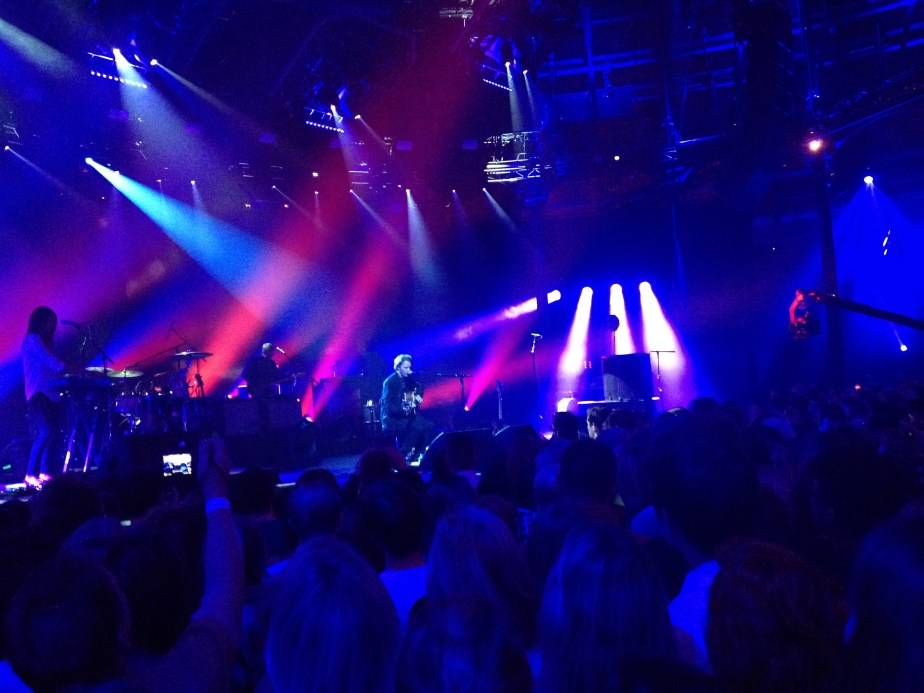
There would surely be people who travelled further than my hour-ish journey to see him. I had been waiting to see him for years and never been able to, and I had been listening to his old album in excitement. Yet, there was a woman in front of me who knew all the words to the only song he’s released from the new album, suggesting there were bigger fans than me out there. How do you think they felt?

Howard also spent a lot of the set sitting down whilst most of the audience were standing, unable to see. Some would have come straight from work, some spending money, no Ben, not on tickets, but on food and drink, and whatever else, to go to the gig. And he’s sitting down. I’m sorry, genuinely, do you have ME? Do you have an actual reason why you needed to sit down? The audience, whoever they are, came to see you. YOU! And you owe them respect if it really was such a privilege to be performing at the Roundhouse after being at The Enterprise a few years ago.

IMG_2396

My friend, Hannah, and I bought lovely beef chilli burritos and sweet potato fries for dinner from The Enterprise – that was the best part of the night. This sentimental comment from Howard just seemed contradictory and his point was made clear as he left the stage without an encore and no old album tracks. Do you think we want to buy the album now? Do you think we’re dying to see him live again? I’m afraid not. It may be fun for the artist to play all new material, but it’s about the relationship between the audience too, and whilst we would have been happy to listen to some new material, it would have been best to also play songs we know and love. Instead, the performance was alienating and underwhelming.

So, some lessons to learn from Ben Howard:
1. Give a mixture of what you would like to do and what you know the audience wants.
2. Put your all into it no matter how big or small.
3. Don’t be a dick: appreciate and respect your audience.

In the Woods