Ben Howard: How Not to be an Audience

I wrote this review on my way home, feeling disappointed at Ben Howard’s performance at the iTunes festival, after moaning with my friend, as well as other vocal fans on the way out of the building. We hesitated leaving as he played just 55 minutes of a contracted 70 minute set, which a commenter told me was meant to include two old songs we had been craving.

However, amongst the commenters who agreed, there were a few that disagreed, and some that we very angry over this post. Although I think the swearing and shouty capital letters were unnecessary, I think it is important to admit where you’re wrong. I watched back at I had been wrong about the trace of narcissism I had initially detected. In fact, this had been a projection of my own frustration at not knowing the songs, expecting to be hearing old classics mixed in with the new, and my height meaning I was unable to see most of the time. When I watched back, I saw that the comments I had thought were rude, were actually bordering on the modesty I thought was missing: Howard’s face looked down as he laughed, as if unable to comprehend the crowd. The importance of body language, eh?

I was also wrong about interpreting him sitting down as lazy. I hadn’t seen him perform and was simply ignorant to his musical technique. In fact, the sitting down was to do with the pedals he needed to press. Other than that, my opinion still stands that the gig would have been better with a mixture of music, and with better audience interaction. So, point number (3) is out, but (1) and (2) still stand for me. Nevertheless, the feeling that I and many others got from Howard could well be to do with what another commenter mentioned: ” If you watch some of his interviews he has tough time dealing with fame and expectations, and that definitely showed last night.” I feel very passionate about mental health issues, and I would hate for my negative words to not be sympathetic to that. Perhaps what we saw on Wednesday was a man who was trying to put his all into it, but was simply struggling, having a bad day.

So, all this got me thinking about the audience, and how reactionary lots of people, myself included, had been after the gig. Some of these points were what other commenters brought up, and others were things that are linked to what I had been saying. During the gig, the audience were standing their like zombies, to the point where I was zapped of energy and was infected with the zombie bug too (plus, with the frustration with my expectations not being met). People nearer the front simply stood there, whilst other areas meant that people talked too loudly, seemingly uninterested with the gig. I think would have enjoyed the gig more had I been sat down in a quiet field with the music blowing through the wind, rather than stood up in building full of bright flashing lights. This happened when I saw Laura Marling at In The Woods festival recently (where I was also performing – yay!) I would have liked to sing along (which I approve of), but people were either silent or talking way too loudly. Music with beautiful lyrics like Marling’s or Howard’s deserve attention. Especially hearing songs for the first time, I want to really listen and take them in.

On this point is the constant need to capture every moment with a camera. I like to have a memento too, but I think after a couple of shots and maybe one recording of a song you love, enough is enough. Put the camera away and enjoy just being there. The most fun I’ve had at gigs is when you immerse yourself in the experience rather than trying to get a photograph that isn’t a big old blur of colours.

So, all in all, I have just three pointers for performers, and four for audience members, because, hey, I can admit when I’m not 100% right, and a gig is, as I said, a mutual relationship between performer and audience. My tips for the audience are as follows:

1.Talking through performances of singers whose music is lyrical and soft. (More so for poetry too!)
2. Constant filming and photography. Remember when you enjoyed just being at gigs?
3. Come without expectations. Or, as I have learnt, you will be disappointed.
4. Remember that performers are human beings, with all their imperfections and complexities.

Ben Howard: How not to do a gig.

So, I’m thinking of creating some tips for artists after seeing Ben Howard at the Roundhouse, where I was on the guest list after being part of the Poetry Collective there. Sadly I had this idea from a ‘what not to do’ perspective as I was utterly disappointed in Howard’s performance, as were many other audience members. Our only solace was a good old British moan afterwards.

A British lad, one might expect that typical dose of modesty. Actually, it looked more like this Venn diagram:

At times he was overly self-critical, saying ‘you know when you wake up and sometimes you’re not funny and sometimes you are, well today I’m not funny.’ Ensue sparse polite laughter (what this meant to be irony?) Yet, as he whisked through songs from his new album, he told fans ‘Is this how it works? You get free tickets, you get what you’re given.’ This felt deeply insulting to the audience; was our time worth nothing? I would have happily had a night at home instead of this gig, and goodness knows I needed one.
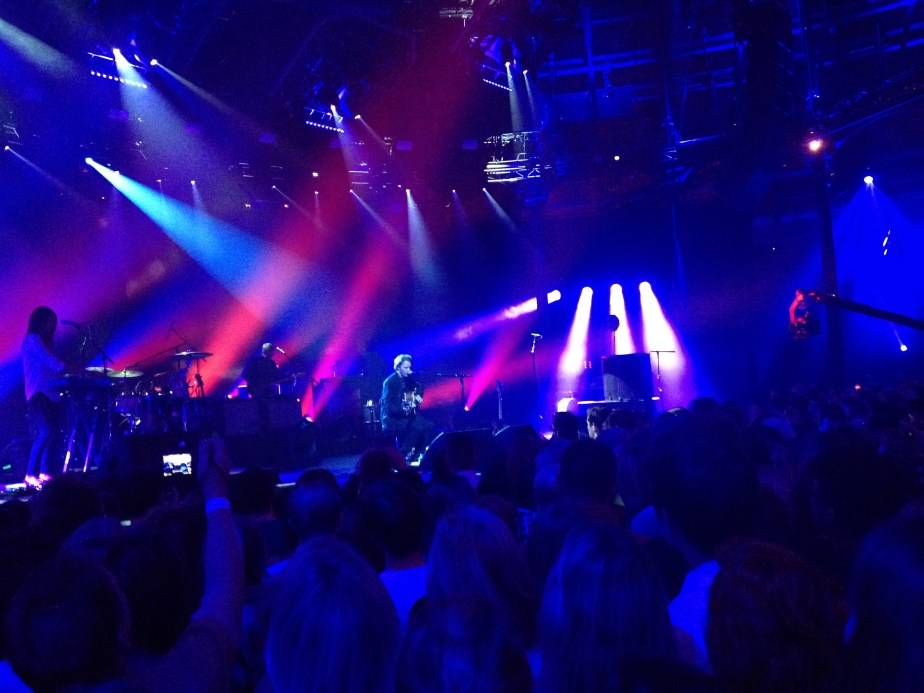
There would surely be people who travelled further than my hour-ish journey to see him. I had been waiting to see him for years and never been able to, and I had been listening to his old album in excitement. Yet, there was a woman in front of me who knew all the words to the only song he’s released from the new album, suggesting there were bigger fans than me out there. How do you think they felt?

Howard also spent a lot of the set sitting down whilst most of the audience were standing, unable to see. Some would have come straight from work, some spending money, no Ben, not on tickets, but on food and drink, and whatever else, to go to the gig. And he’s sitting down. I’m sorry, genuinely, do you have ME? Do you have an actual reason why you needed to sit down? The audience, whoever they are, came to see you. YOU! And you owe them respect if it really was such a privilege to be performing at the Roundhouse after being at The Enterprise a few years ago.

IMG_2396

My friend, Hannah, and I bought lovely beef chilli burritos and sweet potato fries for dinner from The Enterprise – that was the best part of the night. This sentimental comment from Howard just seemed contradictory and his point was made clear as he left the stage without an encore and no old album tracks. Do you think we want to buy the album now? Do you think we’re dying to see him live again? I’m afraid not. It may be fun for the artist to play all new material, but it’s about the relationship between the audience too, and whilst we would have been happy to listen to some new material, it would have been best to also play songs we know and love. Instead, the performance was alienating and underwhelming.

So, some lessons to learn from Ben Howard:
1. Give a mixture of what you would like to do and what you know the audience wants.
2. Put your all into it no matter how big or small.
3. Don’t be a dick: appreciate and respect your audience.

Covent Garden Comedy Club – Saturday 28th June

I got an offer in Time Out for half price tickets to the Covent Garden Comedy Club. The tickets said that the nearest station was Covent Garden; I clearly should have done some research, because it was actually Charing Cross, so we ended up a few minutes late. At the stage, although the host wasn’t Sally-Anne Hayward as advertised, he seemed okay. However, as the night went on his humour jarred with me, until the cresendo of his domestic violence joke. It wasn’t so much the fact that his wife is a black belt in karete and that he chose to use this anecdote (if it was even true), but the way he said it was simply not funny. ‘She was asking for it,’ is not funny when it is a reality that victims stuck in abusive relationships get that message in a serious context, where men are, in most cases, the perpetrator. 

On reflection, the first act of the night, Geoff Norcott, was my favourite from the night. When his name was announced, I got out my notepad and made a note of his name. I hadn’t intended to write a blog post about this night, but after such a contrast of humour and… rubbish jokes… I felt compelled to do so. Maybe due to the fact I’m currently reading Americanah. Norcott managed to discuss matters of racism and sexism with intelligence, and his commentary on human relationships managed to stay human. The part dealing with relationships between men and women was relatable, without being offensive; I started off thinking he was wrong about generalising the way women apologise, but it then got me to reflect and I found myself laughing along. Not only that, but it was funny. I thoroughly enjoyed his segment of the evening and it set a positive vibe, which sadly wasn’t kept up by the rest of the lineup.

After a break, there was a section of two comedians. One of the names wasn’t on the lineup, but he had a posh accent and reminded me of a mix between David Mitchell and Matt Berry. His act was hit-and-miss, but the most memorable part (which I really appreciated as an Academic Mentor) was the reference to a semi-colon. I think much of the reason I didn’t like his act was due to its defence of smoking, and the fact I am becoming less and less tolerant of smokers. That said, there were some funny lines. Nick Dixon was also in this third of the show and he was doing so well, but what ruined it for me was the last reference to women, simply ending ‘it’s hard to find an interesting woman…’ Maybe, just maybe, he could have redeemed himself if he had just made another wanking joke. Or something along the lines of ‘another night alone again.’ Alas, he left the ellipsis there and I just found it another cheap shot coming from yet another all-male lineup.

Lastly, I was so angry and upset by Quincy’s act that I didn’t clap him. Mainly, I thought it was a massive shame and disappointment that he came out with the jokes he did. Part of my anger isn’t even so much directed as Quincy himself, but rather at the world, at the white-supremacist society that dictates mainstream humour. In as much as we had to deal with jokes about domestic violence, we also witnessed Quincy do a disservice to himself as a “person of colour”. Whilst there were one or two anecdotes that were genuine and dealt with race in an enlightening way, the majority was full of the stuff that does nothing but perpetuate stereotypes of black people. With a majority of the audience being white, it seemed that he was catering for this audience, offering them a dumbed down comedy, serving up jokes to do with jerk chicken, Reggae Reggae sauce,  and other stereotypical aspects of black culture that he somehow felt they would find funny. And the sad thing was, they did.

Then it got worse as he ended up being the act that delivered a sexism that said that he actually believed what he was saying. He spoke about the incident with Jay Z and Solange, and said that Beyonce should have put her husband before her sister and acted. Oh, and the fact that he practically applauded Jay Z for not fighting back. Oh well done, congratulations. Because, let’s be serious, whilst I don’t condone her actions, if Jay Z and Solange were both physical in that situation, who would come off worse? What Solange did was wrong, but I will not applaud a man for not attacking a woman. What I hope is that Quincy will improve and let go of this need to people-please (white people) with clichéd jokes based on stereotypes, and not bring in sexist opinions that simply aren’t funny. I believe with more originality, and less tired offensive language, he would stand a far better chance of being a successful comic. With his microphone-stand fiddling and looking over the crowd, rather than at them, I can only assume he’s still got a few things to learn. I don’t blame him as much as I blame society, but I really wish he wouldn’t perpetuate this view of his people, and drive a wedge between POC (a term I’m not entirely okay with using myself) and women as a whole. Instead, take a leaf out of someone like Jamali Maddix’s book on intelligent and witty commentary on race.

It’s so hard to find good comedy nights. All in all, I enjoyed most of what the Covent Garden Comedy Club had to offer, but I feel I have to point out where it fell short. I would go back again, but it would have been nice to have a bit more diversity and a bit less offensiveness. As it was Pride, it would have been good to have someone from the LGBTQ community represented, not to mention more women. Any recommendations for comedy nights that may appeal to my tastes more?

Punchdrunk – The Drowned Man: A Hollywood Fable

The Drowned Man was full of drama, emotion and poetry. I went alone, spur of the moment, having got one of the last £20 Entry Pass tickets the day before. I vaguely knew what to expect and felt nervous upon entering Temple Studios. However, my nerves were replaced with excitement as masked audience members gathered into a lift. Some were released on a different floor, but most of us alighted to a dancing cowboy character.

Somehow, I lost that story-line and ended up following the plot between Wendy, Darlene and Marshall. I picked characters I was drawn to but also tended to stick to the crowd. When I deviated into a room on my own, I got momentarily scared and came out to search for white masks.

I’d spent the first few minutes trying to work out my feelings towards the experience. The only parts I’d say hindered my enjoyment were that there were too many people, and I would also have liked to know whether it would be best to follow lots of characters or just one. The crowds meant you couldn’t hear what the cast were saying all the time; although I’m not sure you always needed to, it would have been best to know what was going on more. At one point it was too crowded to see what was going on, so I followed a woman out a faux fire-exit, but she turned to ask where the exit was. This was probably the worst part (you’re not mean to talk!) – she exclaimed that it was “ridiculous” and so I walked away from her. If you’re not enjoying something, at least respect other’s right to and do what they said and go to the black-masked individuals for assistance.

As the time ticked on, I became immersed in the experience. I hadn’t been to an experimental production before and I gradually tested my boundaries. I thought the play was well acted, the expressionist elements were intriguing and I particularly enjoyed the aspect of dance. It captured the period, but also existed in a surreal place not fixed in this universe. During the scene where the adulterers are caught, I managed to see it from two different perspectives which was interesting. It played with time as you pieced the story together.

Then, I decided to divert from my main characters and followed a woman who interested me. It opened up a whole new story as I read love letters in cabinets. The woman left the room and walked up some stairs. I followed her and she offered her hand to me. I took it and she started running. I ran with her, I heard something drop and went to pick it up (it was my debit card and travel card) then continued to stumble my way down some stairs. It was the final scene and she placed her hands on my shoulders throughout. The voiceover called ‘cut’ and she tightened her grip for a second, before letting go. She took my hand again at the eruption of music. I moved awkwardly as she pulled me towards a box and indicated me to go on it. I stood, wondering what was happening. It just meant I had a good view for the last dance and bow.

I left with a smile on my face, back in reality with secrets running through my mind.

Dean Atta Review

Dean Atta’s ‘I’m Nobody’s Nigger’ (The Westbourne Press, 2013)

Since the book’s title poem went viral, Atta’s debut poetry collection has been much anticipated. Having been a regular feature among London’s poetry scene for many years, it was only a matter of time before he got the recognition he deserved, the recognition poets deserve in general, because it is an exciting time when poetry goes viral. But in my opinion, vival poetry doesn’t happen nearly as much as it should do. I opened the book to the sound of a drumroll. Immediately, I enjoyed the contradictions of language, the juxtaposition of words, and the simplicity that can be read into on so many levels.

Yes, viral poetry doesn’t happen enough, yet Atta’s example shows poetry at its best. It is honest, meaningful and has something important to say. In this poem lies a couplet containing raw commentary on a society where ‘stacking paper cos it’s greater than love it seems/call me ‘nigger’ cos you’re scared of what ‘brother’ means.’ Within this poem there is an undeniable power, and there are more moments than this which get your fingers clicking in appreciation.

As the review in Urban Times stated, the one criticism the collection falls prey to, is not getting the balance between ‘page’ and ‘stage’ quite right. That said, maybe the point is to simply get the word out; Atta’s reputation as a performer means that it would be ridiculous not allow his audience the privilege of reading his work. And like I said, the message he delivers is important. What’s more is that he does it in a way that is not so didactic as to make the reader feel preached upon, and in a way that makes him human; “in arrogance and creativity” he paints a picture of society’s troubles in ‘Fatherless Nation,’ with an awareness of his own shortcomings.

Another major highlight of the collection is ‘Key to the City,’ a modern love story featuring John and Melissa, which twists like a knife as you turn the last page of the poem. With many poems exploring sexuality, ‘More Than This’ stands out as one of the best, with great use of alliteration and carefully chosen words, from the first line ‘I knew, before we’d even spoken’ and the image of a night where ‘mouthfuls of beer dislodge illicit imagery,’ to the last line returning to the title.

‘My Love’ is a great example of where page and stage meet, as the rhymes are timed well and thoughtful, words are packed with meaning and the poems forces you to image Atta performing the piece. It mixes humour with sorrow, in images such as ‘It’s glass half empty/Amaretto on the rocks/A friendly drunk/makes love wearing socks.’ Lastly, the poem ‘Lost in Time’ stands out as it is so relatable; my own mind is vivid with memories of a childhood now past. Atta’s collection tells a story of contemporary society in a patchwork of poems about race, sexuality, culture, class, relationships and even poetry itself. What is so important about Atta’s poetry is that it now exists as what will be a relic of our time.

Schwitters in Britain, Tate Britain: 30th January – 12th May 2013

It seems apt, for Kurt Schwitters, to be the pioneer of an underrated art form: the collage. Whilst some of his contemporaries may be more recognisable to the average person, Schwitters’ influence is often overlooked. In fact, he was a revolutionary Dadaist; making art out of anything and everything, he created the concept of Merz, ‘the combination, for artistic purposes of all conceivable materials’. So, when you question ‘is this art?’ with reference to 21st century artists, you have the likes of Schwitters to blame. Interested more in the aesthetics of his work, Schwitters himself would dissuade viewers to look for a deeper meaning than a record of modern culture at the time. However, what is interesting about the visual arts is that, like poetry, the audience can interpret the meaning as they wish.

Schwitters proves his technical ability through his portraiture work. Yet, it is the collage that really makes you think. You peer closer to inspect the materials, the texture, the composition. The apparent juxtaposition of various papering is sometimes amusing, such as an untitled piece with an early portrait of the artist himself (1937-8). Others seem to suggest a sense of despair and melancholy, for example, En Morn (1947) which included the words ‘these are the things we are fighting for’ alongside scraps of newspaper, chocolate wrappers, and bus tickets. He extended this work beyond the flat surface with collages of objects such as Merz Picture 46 A. The Skittle Picture (1921). As you walk around the Tate Britain gallery space, you can’t help but wonder beyond the pure visual surface to depict a meaning.

Other highlights of the exhibition include the cabinets of articles and letters, which include rejection letters. These provoke a feeling of hope due to his obvious success, with the knowledge of his reputation and influence in the art world today. The sound poetry Ursonate (1922–32) plays alongside shots of Schwitters reciting the piece. This complements the visual components of the exhibition, whilst also giving further insight to the history behind the work.

Fleeing from Germany and eventually ending up in the Isle of Man, Schwitters was detained in a camp there as an enemy. This gives practical reason for Schwitters’ need to create from found objects and scraps, given that there were limited resources. He also created pictures of his confined surroundings. However, he continued to push the boundaries of what it means to be a painter, even after his release in 1941. He created sculptural work such as Untitled (Opening Blossom), dated 1942-45 and Painted Stone (1945-47) which again looked at the idea of surfaces and texture, and showed the abilities to be free of apparent limitations of the medium of paint, as something which must be two-dimensional.

The Merzbarn is the crescendo of the exhibition and epitomises how radical Schwitters’ artistic practice was during this time. He started creating the piece in 1923, and on his third attempt at its manifestation; it was still unfinished when he died in 1948. It shows Schwitters as a true artist, whereby art is his lifeline. His passion for creation was all-consuming. Such a grand installation shows how inspirational a figure Schwitters has become, and this is translated by the end of the exhibition through the exhibition of inspired work from Adam Chodzko and Laure Prouvost. Whilst Chodzko takes on the more architectural and environmental, exploring the contextual side of the work, Prouvost shows a video installation and creates a narrative based around a grandfather figure, looking at the way an artist has no control over interpretations of their work.

Reviews

My reviews are of the Dorothy Parker variety; I mix my background with academia with casual language that make my writing accessible and interesting to a wide variety of people.

  1. Enquire first by email to carminamasoliver@hotmail.com, where address will be given.
  2. A free review copy should be supplied.
  3. Please provide at least one link to a site where the item can be bought and/or a list of booksellers where it is stocked.
  4. I may add additional links to other sites if I feel it appropriate.
  5. Review items are sent on the understanding I may not like them and my subsequent review will reflect this, however, my philosophy is to be both positive and critical.
  6. Reviews are done for free (the only cost that is incurred is that of the free review copy) and therefore the deadlines set will be dependent on time restraints and other commitments.
  7. I will review self-published/produced items.
  8. It will help to have a web presence.
  9. I reserve the right not to review any unsolicited items, i.e. items sent without an enquiry first.  If you have enquired first and I have agreed to review the item, I will review it.
  10. After a debate on women and poetry at Poetry Parnassus, I am particularly interested in female writers. I’m also more interested in poetry, but will accept other genres.