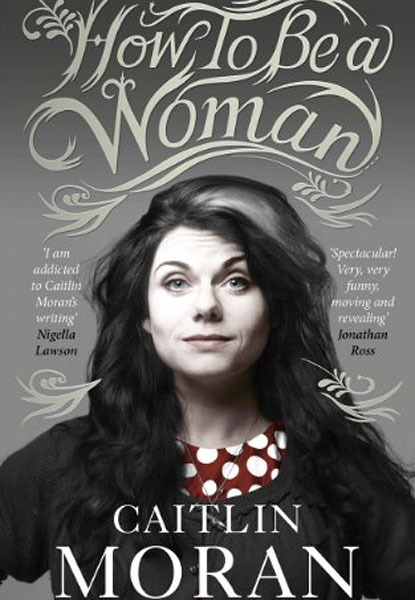
I was really excited to start reading Caitlin Moran’s How To Be a Woman, but I wasn’t sure what to expect. The tone is very accessible, which isn’t something I am usually keen on, but I think that’s her point. For Moran, feminism isn’t something that only women should care about, or even a certain type of woman. And damn right. I’m sick of women not knowing they need feminism and this book’s appeal to the mass market means that maybe the women who aren’t interested in women’s issues will realise it’s nothing to do with men-hating and maybe they will be able to see the inequality that still exists in the world.
I wasn’t expecting such an autobiographical text. However, on reflecting on the discussions within the UEA Feminist Society, I realise that this is a great way of communicating feminist topics – through recounting experiences and assessing the problems. In reading this book, it is impossible not to have an opinion. Due to disagreements within feminism, there is not a hard-and-fast manifesto of feminist utopia. We all have to come together and offer our opinion, to come to a compromise about what is best for both women and men of every race, culture and class. We have a long way to go. So, I thought I’d attempt to give my thoughts on some of the topics Moran covers. I imagine this will be longer than a blog post should be, yet shorter than a book.
Moran was inspired by Germaine Greer’s The Female Eunuch and so from one generation to the next, I will be using this book as an inspiration to give my two pennies worth. Although the age gap between Moran and Greer is almost triple that of mine and Moran’s, it would be too complex to do this with The Female Eunuch, which I have also read. Moran’s ideas are all easy to follow, whilst, when reading other more ‘intellectual’ writers, such as Cixous and de Beauvoir, there can be parts that go over my English-Literature-BA-(Hons)-2:1-head (I recently graduated – yay!). A little less high-brow than Butler and Appignanesi, this is a book you would enjoy reading on the beach or by the pool on holiday; this is a book that will make you run up to the diving board and shout ‘I AM A FEMINIST!’ before taking a big plunge.
Speaking of Greer, Moran comments on how she doesn’t agree with all her views. This reminded me of a poem I wrote in response to an article Greer wrote.
Germaine Greer
Germaine Greer writes about Mrs O’s dress
As the USA gets its first black president.
The Guardian call this news that they press
But it’s worth about as much as 50 cent.
It’s like taking one step forward and then two back
And demeans the event for the sake of controversy.
As the world celebrates the result for Barack,
Germaine Greer points out the bits that we failed to see.
The dress looked like a butcher’s apron
And the children were not girly enough.
Glad that I’m not one of them;
I wouldn’t be caught dead in that stuff!
Oh, Germaine Greer, as an academic scholar
Are you trying to tell us feminism is dead?
If this is your idea of irony, it isn’t worth a dollar,
If it’s a joke, I’d say be serious instead.
Germaine Greer what is feminism now, in your books?
Should we judge what every other woman wears?
After all, a woman’s role is shown by how she looks
And her importance equates to the number of male stares.
Germaine Greer did you not know we still fight
To be considered equals to men?
Should I be ashamed to say I’m a feminist and want my right?
It bleeds out through the ink of my pen.
Anyway, back to Moran. She begins on what many people would see as the first step to becoming a woman. Periods. Now you can (technically) have sex and reproduce, and you are open to the complexities of life and a have to plan your life around the damn thing. Luckily, my periods haven’t been as traumatic as those described in the book, but it’s still an extra pain in the arse, or rather a pain in the vag I guess. So, on top of my number one annoyance (hair removal – both especially annoying when it comes to sex) that women have to plan their life around, the period is there to disrupt things and I’m sure everyone would wish it didn’t exist. Because even if we are glad to be a woman, it is not something we can ever be ready for (and certainly not at age 11 or whatever) but we get used to it, like THAT customer that comes in every so often on your part-time retail job “not you again” we think. Things like counting down the days to realise it’s going to clash with a festival, or holiday, or anything that we actually want to look forward to. So, the first sign of becoming a woman appear to be that it is annoying, unfair and, as Moran put it, BULLSHIT. But, we can’t blame the patriarchy for that, so, let’s moves on.
As I have said so many times, I have given in to the pressure of hairless airbrushed images and try to remove as much as possible whilst still retaining an element of “womanliness” (I’m not going to spell it out). However, rather bizarrely I haven’t been for a wax since reading itMoran, what have you done to me? (Edit: I have had one since writing this as I took so long to get on with finishing it). I’m pretty sure it’s for practical reasons (time and money) rather than brainwashing. I did find this section very funny though, because a lot of the time, I don’t think men understand that woman are also born with hair all over our body and that ours is just generally thinner and lighter in certain places. One friend, describing these dilemmas says ‘I can’t budget correctly with all these “Random Fuck Factors” in my week. No wonder everyone’s a slag these days. Even if you don’t like anyone at the party, you want to get some return on your wax” (p. 49).
Even though this is humorous, I personally disagree with the term ‘slag’ (it’s too long to go in right now) and I also feel it should be noted that not all women get waxes “for” men – it helps with confidence (in addition to during sex), cleanliness (being “groomed”) and makes you feel like, not just a woman, but a strong woman. I got my first wax when I was 21 and it was a sign of being a woman prior to getting it done, but afterwards, I thought ‘wow, that was worse that any boy has broken my heart; now I can cope with anything, I am a STRONG woman and I can take on the world.’ Though it’s partly funny, it’s also rather tragic, and this is pin-pointed by the idea that these thousands of pounds we spend on hair removal is ‘just to look normal’. It is then my thoughts escalate to thinking that sanitary towels and hair removal should be on the NHS. It’s just not fair!
Moran makes it clear that men can be feminists too, but she does confuse the point on page 79, when she states that working out if you are a feminist is determined by asking yourself ‘Do you have a vagina?’ and ‘Do you want to be in charge of it?’ I wouldn’t say it that way myself, but it makes clear that her target audience for the book is female, and to be fair, she’d be right – not many men would read a book entitled ‘How To Be a Woman’. So, time to move on again.
She mentions ‘Girl Power’ which I know has been criticised for different reasons, but, thinking back, it was the Spice Girls that made me aware of any vague notion of feminism, so it can’t be all bad. My favourite was ‘Sporty Spice’ and as I’ve always been quite “girly” really, it probably helped make me who I am today – happy to be “girly” but uncomfortable with stereotypes and equally happy to challenge the idea that my gender stops me from doing anything, for example taking up boxing, cutting my hair short, drinking lager, and being an internet nerd (stereotypically speaking again). I saw a boy drawing flowers and his older brother (or someone else who should have known better) telling him flowers were for girls and I said ‘no, everyone can draw flowers’ or something to that effect.
Forgive me if this is all a bit slap-dash, I read the book a while back now and made notes in my phone and am writing this very sporadically and trying to make sense of notes. At the moment I’m trying to work out what ‘pc words, bitching hmm, underwear, nt all about men’ means. Okay, I have now found the point in the book about political correctness. Personally, the whole thing irritates me; the fact that people need others to tell them about what is right and wrong. And Moran states that ‘people keep using the phrase without really knowing what it means’ (p. 84). This is true, but more so, that people hear the word feminist, and misjudge what it means.
She moves on to the topic of bitching. I find this difficult because I believe that bitching is not nice, and that as a human being, and not ‘as a woman’ I believe niceness is underrated. However, I am now reading Odd Girl Out by Rachel Simmons which is largely about how women are expected to be nice and these expectations lead to alternative aggressions, which are usually psychologically damaging, as opposed to physically damaging. This whole area is complicated, as there is a difference between letting off steam, and bitching, which is the intention to hurt someone. And I believe that the whole idea of setting women up again other women is very dangerous. I know women who have been scornful towards women, and I find that shocking and unpleasant. Women need to be supportive of one another and inspire each other, because men are already in competition with us on an uneven pegging field. Plus, Moran’s whole ‘being polite’ (p. 87) is kind of contradictory when you take into account the acceptance of bitching.
I found the part about over-eating interesting (p. 117). I know I’m mostly healthy but I think maybe I could be healthier (okay, and that would correlate with being a tiny bit slimmer) and this is mainly due to the fact I eat too much. I can be sensible in the day, and count my fruit and veg and water intake, but when evening comes it goes downhill – if I am not eating a 2-person portion and having a compulsory chocolate-based dessert, then I would be piling on the pounds with alcohol. Perhaps this is why I am able to talk about how much I ate in the same humorous way Moran describes a shepherd’s pie indulgence; because I am only fat in model terms. I remember when I did feel I was overweight, which was likely just a bit of teenage puppy fat, and I would never tell anyone how fat I felt, because ‘the only people who aren’t talking about it are the only people whose business it really is’ (p.118).
I find it hard to pinpoint where I have encountered sexism because I feel it is so engrained in society, and throughout my childhood it has been somewhat acceptable. When I hit puberty, I didn’t even know that men’s making me feel uncomfortable by “cat-calling” was a feminist issue, it just seemed it was another part of life you couldn’t control.
Relationships and the subject of love are also complex because of the different areas that come up; it can seem like a power struggle when there really shouldn’t be one. From monetary matters to those of sexual behaviour, to the idea of adhering to ‘rules’; women’s relations with men are bound up in these issues.
Another subject matter I find interesting is that of performing as a pole dancer or burlesque act. As I have performed a few times as a pole dancer and I have watched a couple of burlesque shows, I know there is a fine line between the seedy strip bars, and the more artistic performances. Moran states her ‘rule of thumb’ is as to whether gay men flock there because ‘they are up for glitter, filth and fun – rather than a factory-farm wank-trigger’ (p. 176) which makes sense but is a hardly scientific measurement. It is also about the intentions of the viewer. I have performed my pole routine in front of a large audience at a talent show, and although the judges tried to remain unfazed, there were still innuendo comments about male students’ responses. This made me uncomfortable as it was about strength and confidence, and the creativity behind the dance, rather than anything sexual or seedy. I have an idea for an event, at this stage (being in my head) called ‘Poetry and Poles’, whereby pole dancers can perform beautiful routines alongside poetry in a space other than trashy clubs and bars. In the same vein as pornography, women should be free to choose these paths, but without the derogatory and demeaning contexts.
The section on marriage is another good one. When I was at secondary school, and had no contact with the opposite text other than teachers and family, I thought marriage wasn’t for me and that I would be a “career woman”. Although my aspirations for a successful career have not changes, these things some call maternal instincts have kicked in and I have recently found myself wanting a family. Not now, but, at some point, probably from the age of 25 (although this is not something anyone ever has a choice about, obviously).
The religious reasons for marriage would not be my reasoning, but I would like a celebration of love and unity. I find the cost of weddings horrendous and I would want to keep my as cheap as possible, going for an understated but beautiful ceremony, with practical presents. I do also like the idea of a fun hen night with my girl friends, the honeymoon; the whole shebang. In terms of guests, I can’t stand massive family gatherings where I find out I have relations I didn’t know existed, or don’t remember what they look like; I’d want close friends and family only to avoid this awkwardness. After years of shaky birthday plans, I can understand the huge pressure the day would have to be ‘the best day of your life’ (p. 182) which is why it would need to be a simple and small as possible. Moran reiterates this by stating ‘the quickest and easiest way to kill the fun good-times is to put a massive pressure of expectation on it in advance’ (p.193). I also wouldn’t want to change my name. I do that thing when I’m with a guy I like, try out their surname, and it never sounds right, not that I would have the intention to do it. I would like to include it in some way, but who knows how, my name is long enough already!
Next up, fashion. Again, the fashion industry is flawed, with all the horrible size-zero malarkey. But, blame the Barbies, whatever, I do love a bit of fashion. I’m not a great follower but I think it’s easy enough to keep up to date just by shopping, as I don’t just blindly follow and like to pick and choose what I like. Starting with shoes, I tend to wear the same ones and am a massive fan of the mini-heel. The last attempt to wear this great pair of platform black heels ended up with me (amongst all of my friends) changing back to a lower heel five minutes later. People tend to associate shoes with me and buy me presents connected to them, and I have always enjoyed drawing them in art classes. I think their just beautiful objects and by owning different shoes, I can beautiful myself. Though never wearing nice heels defeats the purpose somewhat!
In terms of handbags, I am a big fan of Chanel handbags. The only problem is, I can’t afford them. Therefore, I try and get the nearest possible high street version – the best being from Marc B (at Topshop). However, I use bags to death, and like my favourite shoes, I tend to hold on to old scrappy items. As for clothes, I frequently encounter the ‘I have nothing to wear’ (p. 211) problem, despite my bulging wardrobe. I still look at clothes and want them (to the extent that it is too painful to look at clothes because I know I can’t buy any). On a more serious note, I find the idea that ‘a woman is still to blame for being raped if she dresses ‘provocatively’’ (p. 209) disgusting, and that is why I support things like the Slut Walk.
Moran states two cases for having children, and not having children. As I state previously, I used to not want children, but now I would like children when the time is right. I think it is a personal decision, and that’s why the argument about an over-populated world being a positive about abortion exists solely as a comfort for those having an abortion (i.e. not the other way around). On the topic of abortion, I am pro-choice but it is never something which I would personally do, because it is a personal matter. For myself, I know my parents could have aborted me but they didn’t, and although it was hard work, having children is never going to be easy and always involves sacrifices. There are all sorts of complex reasons for a woman having an abortion, and I have friends that have had abortions. If I think more deeply, I would consider having an abortion if there were tests for a life-shattering disability because I believe the child would not lead a pleasurable life, and I would not want to be a carer of a child with such an upsetting disability.
The points I don’t completely agree with are as follows. Firstly, there is the idea of ‘good’ and ‘bad’ abortions (p. 272). Although I agree with the basic idea of it, in that one should not be judged for their actions, regardless of the reasoning, I disagree with the ‘repeated abortions, late-term abortions, abortions after IVF’ (p. 272). In regard to repeated abortions, if an abortion becomes a regular occurrence (common amongst teenagers) then this is an education issue and that person needs to take responsibility for their actions and take precautions in future, or they are not learning from their mistakes. Late-term abortions, I can have some sympathy for, because this decision is extremely difficult, and at times you may not even know you’re pregnant until very late, but this is also very dangerous. For example, the experience Tracey Emin has described, which was through no fault of her own, sounds devastating. As for abortions after IVF, I don’t understand why anyone would do that, unless there were other factors. Secondly, I find it unusual that the grief and guilt ‘never arrives’ (p. 283) for Moran, post-abortion, as I think any human would be emotionally changed afterwards, and someone I was friends with had an unemotional reaction and it just strikes me as cold and strange, but, that said, a woman is perfectly able to be so. I can’t help but think there would be some underlying emotions that are not being dealt with, even if it was due to outside opinion.
Overall, the book does the job it intended and has friends of mine who once wouldn’t have called themselves a feminist, doing just that and it makes me so happy. If this book can do that to a mass audience then it will do a world of good. One large point that it does not tackle is the issues of the wider world, as there are countries where women face horrific injustices. But, we do have to start somewhere.

 Poet on page and stage. Creator of She Grrrowls. Facilitator. Writer.