On Tuesday 26th June I attended the first day of Poetry Parnassus. Having felt quite confident and happy about going on my way, once I got there I did feel quite overwhelmed. Simon Armitage – one of my first encounters into contemporary poetry at GCSE’s – was standing just a few metres away. There were poets from all over the world; the idea curated by Armitage saw poets flocking from all of the countries competing in the Olympics. This day was the World Poetry Summit. Poets, publishers and other important figures in the world of poetry gathered and I felt a little like I was watching from the margins. I was disappointed only in myself for not taking the opportunity to seek out like-minded people, but still, I did absorb my surroundings and scribbled away at my notepad.

Reflecting on my notes now, I shall summerise some of my thoughts in relation to the day as a whole. My notes are 2,317 words, so I hope to make this much shorter! The first point is one which has people divided. Jude Kelly, the Artistic Director of the Southbank Centre, made a comment about how it is a positive thing that poetry remains uninfluenced by money. She expressed the view that we shouldn’t want to professionalize the arts. Those with more romantic or anarchistic views may agree. However, I think that you have to bear in mind that we live in a Capitalist country and therefore the rules apply that we need money to survive. It would be idealistic to think that we do not. This very statement is contradicted by the fact that the poets and other speakers at this conference are professionals. They have a right to earn money from dedicating their life to poetry.
Though it is just another fact that they must do other things alongside the actual writing of poetry, their work doing these other things (teaching, editing, speaking at events etc.) is informed by this dedication to one field of practice. I agree that accessibility is important, however, it is worth noting I had to pay the full price of £35 for the summit, as apparently I had missed the “limited concessions” price – something which I don’t quite understand as I’m pretty sure I was one of the youngest people there. However, this kind of balanced out when you take into account all the free events I went to today. It is important because I almost didn’t get a ticket because I had to pay full price. I also almost didn’t come to the free events because of travel and my MA work commitments, but I thought this was too significant an opportunity to miss.
I went to half of the talk about poetry and money, and half of the Tradition vs. Innovation talk. The fact that there was a debate about money suggests that the above statement from Jude is not quite a given; she states in this discussion that it is ‘the elephant in the room.’ What is clear is that to be a poet, you must take on other work and Ollie Dawson, the Director of the Poetry School, found that younger poets are more willing in this area. Representing Kenya, poet Shailja Patel spoke out from the audience and told us that in the USA, there is a National Writers’ Union. It helps with issues of copyright, healthcare and so on and seems like a fantastic idea.
Tradition vs. Innovation was good to listen to as I had just been reading Adventures in Form, which is the most interesting book I’ve read since Dorothy Parker’s collected works and has me itching to write more poems. Tom Chivers from Penned in the Margins was involved in the discussion and made the point that they are not actually opposites as they feed into one another and that there is a “spark” when such concepts meet. Hence why this new book from Penned in the Margins is so exciting.
In a discussion about literature in the digital age, Nikola Madzirov spoke about horizontal and vertical dialogues. Thinking the web is more of a… web, so more sporadic than those ideas present, I got a bit confused here. Can anyone shed light on the meaning of this? I thought the work that was being produced could be in danger of being a bit gimmicky, but that the thought of having poets from around the world performing digitally at StAnza also seemed like a unique kind of festival, opening us up to people we may not normally come across, other than on rare occasions such as Poetry Parnassus!
In a conversation about poets finding their way in the 21st Century, Kayo Chingonyi proved to be one of my favourite speakers. He had a clarity, knowledge and passion that was articulated exceptionally well. Though it has to be said that Dean Atta made a delightful statement about wanting to be made into a hologram which made us all smile and chuckle a bit. I also felt I connected to some of what Raymond Antrobus said about there being a difference in writing to yourself and from yourself. My poem, Drama, actually comments upon this dilemma that I have faced as my urge to write in the past has come from a cathartic impulse that seemed only natural to me, whilst I have been over the last few years to perfect it as a craft.


After the provided packed lunch listening to poetry from around the world upstairs, I went to the Poetry & Elitism discussion. Bas Kwakman begins with the statement that ‘political poetry is always bad poetry. Good poetry is always political.’ And so ensues a discussion that (like the Tradition vs. Innovation talk) deals with binary oppositions. In my dissertation for my BA I examined Sarah Kane’s 4.48 Psychosis and my distaste for binary oppositions began there. As Taja Kramberger asserted; it is a ‘false dilemma.’ The whole point of elitism is that there isn’t access for the so-called populist, and then the populist itself becomes a different kind of elite, creating yet another hierarchy.
Another one of my favourite speakers, mentioned earlier, Shailja Patel spoke about the fact that there is a common misconception that equates elitism with difficulty, and populist with the political. This was in response to a elite-defender, who, like Bas, seemed to assume that some sort of elite was needed to ensure quality. Oh, the commoners can have their populist/political shit and we can just carry on here with our poetry of superior quality. No. Patel made her points extremely well in the debate, but also actually recited a poem ‘For the Verbal Masturbaters.’ She told us that she never takes free speech for granted as she did not have the privledge growing up. So much of this discussion relies on privilege and, in my view, anyone that defends elitism is a privilege-denier, or just needs to think a bit more.
To end this section, a quote from Taja Kramberger – ‘Poetry: you are not made from words alone.’


That evening I met up with my old housemate, Kirstie, and we caught poetry that fell down from the sky with the Rain of Poems. It took some time before I got a couple of poems, pictured below. People went crazy and almost physically fought over it, with some people greedily giggling at their hand-fulls. I’ve never seen people so excited about poetry, I thought. Slightly cynical about it, I thought that a lot of people would not treasure the poems as they should. Still, it was very surreal and pretty as they fell and glittered down to us.
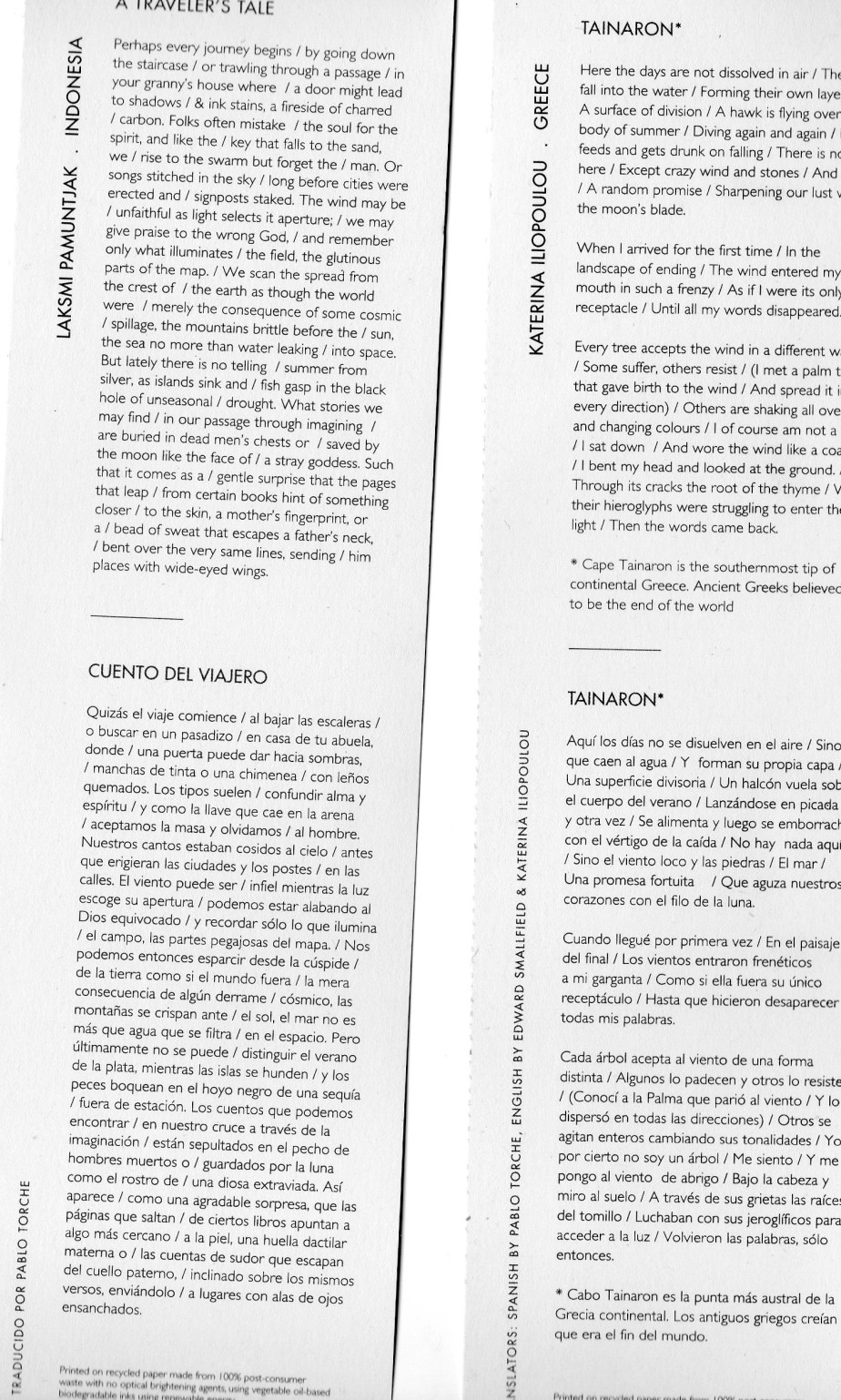
Today, Saturday 30th June, I went back to go to more free events. I thought I also may get the opportunity to speak to some others there but didn’t see anyone I knew and didn’t feel I could randomly strike up a conversation with someone else. I first went to WOW (Women Of the World) Breakfast. This was one of my favourite events, and it was FREE! I forgot my notebook today so made just a few pointers in my (non-smart) phone. The discussion about writing from the mind/body brought me back to the idea of binary oppositions and those false dilemmas again. Sadly, I can’t remember the names of anyone to write who said what, but it was disheartening to hear that one visiting poet from Africa has said she was ignored even at Poetry Parnassus. Upon her own success, she was called up and told ‘African women don’t write poetry, it’s for African men.’ There was a man that enthused about the amount of young women with desire to write, as a cry for some positivity. A young woman also made some comments about not feeling ‘hard done by’ and again at the end that she was ‘not fight, just enjoying every word.’ However, I think that by doing just that and nothing else, you are ignoring and placating the wider issues that are a reality that women are faced with all over the world.
I plucked up the courage to ask a question, which thankfully they squeezed in for me. I wanted to know, as a student, since the majority of people who study Literature and take writing courses are women, does this filter out? If so, why… and, do they have a chance at a level playing field or are they at a disadvantage when it comes to publishing? Picking up on something they said earlier about a need for more female editors, judges and critics, I questioned whether a way forward may be for bloggers to review female books. Some interesting thoughts came out of this, but it still remains to be answered in the future. I got home and found a Facebook comment thread about female writers not submitting enough.
So, part of this may be to do with confidence, and a willingness to take risks and perhaps not possessing enough of the characteristics of being a creative entrepreneur! The career progression from university also needs to be more informative, useful and supportive. Although there are issues with blogging, in that they’re unpaid, I had recently thought that I would LOVE to receive free books if I could review them on my blog. I believe I have a fair amount of readers but it would also be something I could build upon. I have had some experience writing reviews but I would love to do more. Whilst I am still at the beginning of my career I wouldn’t mind sparing some time to read and write about what I love! I may take more of a Dorothy-Parker-esque way of writing about the events, exhibitions and books I experience, but at least I’m honest!

After a small break reading The Ode Less Travelled by Stephen Fry, I went to the Clore Ballroom for some Salt readings. It was good to see Chris McCabe as Tom Chivers had told me about him when I did my internship at Penned in the Margins and I had read some of his work in the latest book I mentioned earlier. He read poems about a meat-book, explaining a Van Gogh painting to his son, and existential clubbing. Kayo Chingonyi has to be mentioned again because he was one of my favourite poets of this day as well! He read poems about how to create a mixtape on the out-dated cassette tape, as well as taking us through the rhythm of his dance. He also seems like a really nice, genuine guy, which always makes me like the poets even more.
Sadly, Death Poetry was full, so I found life outside and read a bit more before going back to the Level 5 Function Room for ‘They Won’t Take Me Alive – Women and Revolution.’ Namechecks to Alaide Foppa, read by Amanda Hopkinson, Gioconda Belli, Chiranan Pitpreecha and Farah Didi. Bidisha also did an amazing job as chair for this and the earlier WOW talk. I was so glad I stayed for it because I learnt a lot and it was wonderful to be able to hear their poetry. They spoke of the ideas of poetry and activism, comparisons to fruit and flowers and images of beauty, and showing the world what injustice there is and moving on to other subjects, how this political voice is at the core of you. I made out about 5 words of Gioconda Belli’s Spanish recital of ‘The Dream Bearers’ which makes me morn for the lost language of my hispanic roots. Still, I have uploaded some free Spanish tutorials on my iPod now.

Wow! So, over 2000 words means I better stop! Full from tapas, and looking forward to Sunday-Tuesday as I celebrate a year of being with my boyfriend 🙂
xxx

 Poet on page and stage. Creator of She Grrrowls. Facilitator. Writer.